Monday, April 8, 2013

A Welcoming Kind of House


"Cecilia's and Emmeline's house was in Oudernarde Road, which runs quietly down into Abbey Road, funnel of traffic and buses. It had big windows, arched stairs and wrought-iron steps at the back leading down to a small garden. Cecilia, hesitant over the agent's order, looking about at the temptingly sunny spaces of floor, had remarked: 'It's a long way from everybody we know...' But Emmeline said: 'We never know whom we are going to meet.' From the first glance the house had smiled at them and was their own. So here they had settled." 

--  from "To The North" by Elizabeth Bowen

********

I have always loved this quote from To the North by Elizabeth Bowen. It is a poignant book about two young women in their twenties living together in London and finding their place in the world. One is an orphan and the other is newly widowed. Finding the right house is of paramount importance to their sense of safety and stability. The idea that "the house had smiled at them and was their own" struck me as so true. It made think about the elements that go into making a house a welcoming kind of place, a house that smiles at us and shelters us from the storm. A house that we love and and want to make our own. Of course it is different for everyone, but here are some ingredients that I think make a house a haven.

A cheerful front door

A cozy sitting room 

A fireplace

Window panes to look through on a rainy day

A sunny kitchen

Blue and white crockery

 A room with a view

A snug bedroom

A touch of tartan

A smattering of red

A room to call our own

Books and flowers

 A writing desk

A reading nook

Candlelight

Outdoor seating

Climbing roses


And last but not least, there is a certain something, a quality that is hard to define. It could be the lighting at dusk, the patina of the bricks or the fragrance of the garden. We may sense past generations who have lived there and we feel a connection. The emotion is strong, even mysterious. We are at home.


Images via Pinterest
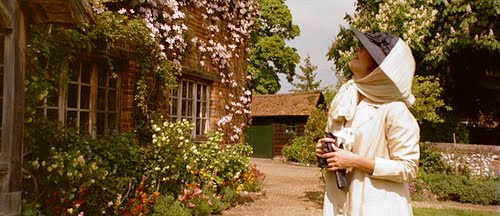
Last image from Howards End

Friday, April 5, 2013

Enchanted April


"She jumped up, pulled on her slippers, for there was nothing on the stone floor but one small rug, ran to the window and threw open the shutters.  

"Oh!" cried Mrs. Wilkins.

All the radiance of April in Italy gathered together at her feet. The sun poured in on her. The sea lay asleep in it, hardly stirring. Across the bay the lovely mountains, exquisitely different in colour, were asleep too in the light; and underneath her window, at the bottom of the flower-starred grass slope from which the wall of the castle rose up, was a great cypress, cutting through the delicate blues and violets and rose-colours of the mountains and the sea like a great black sword.

She stared. Such beauty; and she there to see it. Such beauty; and she alive to feel it. Her face was bathed in light. Lovely scents came up to the window and caressed her. A tiny breeze gently lifted her hair. Far out in the bay a cluster of almost motionless fishing boats hovered like a flock of white birds on the tranquil sea. How beautiful, how beautiful. Not to have died before this...to have been allowed to see, breathe, feel this...She stared, her lips parted. Happy? Poor, ordinary, everyday word. But what could one say, how could one describe it? It was as though she could hardly stay inside herself, it was as though she were too small to hold so much  joy, it was as though she were washed through with light." 

-- from The Enchanted April by Elizabeth Von Arnim


Enjoy the first weekend of April!

Monday, April 1, 2013

Lovely Workspaces

I am intrigued by the rooms where creative people work. Writers, artists, interior designers, fashion designers, gallery owners, museum directors, entrepreneurs -- their choice of a workspace is fascinating to me. Do they keep it austere and serene or do they load it with inspiration? Do they work best with images on a bulletin board, favorite books on bookshelves, precious writing implements on their desk, windows with a view, great lighting or privacy? What element is most important to them? What are the ingredients that go into making their workspace a retreat, a haven where they can be creative? As Virginia Woof wrote, "A woman must have money and a room of her own if she is to write fiction." I am not sure that money is essential (think of J.K. Rowling), but a room of one's own seems to be ideal. Here are the workspaces of some very creative people. 

 Vita Sackville-West's writing tower at Sissinghurst Castle
Photo by National Trust John Hammond via here

What kind of a room does a writer need to produce great art? Vita Sackville-West, descended from British nobility, had her own tower at Sissinghurst Castle in Kent, England. It had views of the famous gardens she created. It was there that she wrote her novels, poems, essays and gardening articles. She was surrounded by her treasured books, Persian rugs, antique tapestries and portraits of her literary idols -- Virginia Woolf and the Bronte sisters.  

 Virginia Woolf's writing lodge
Photo by National Trust Eric Crichton via here

Virginia Woolf writing lodge at Monk's House, her home in East Sussex, England, was a much simpler affair. A former tool shed turned into a writing room, it was situated in the garden and had a view of the downs. This is where she wrote parts of all of her major novels. 

Virginia Woolf's desk
Photo by Eamonn McCabe via here


Edith Wharton's bedroom
Photo by Annie Leibovitz via here

Edith Wharton famously wrote her novels in bed, dropping the pages on the floor for her secretary Anna Bahlmann to gather up and type. Here is a recreation of Wharton writing in bed at her home The Mount in western Massachusetts, photographed by Annie Leibovitz for Vogue Magazine. Wharton wrote "The House of Mirth" in this room.


Jane Austen's desk
Photo by Eamonn McCabe via here

Jane Austen wrote at this desk near the front door of Chawton Cottage, her home in Hamsphire

 Haworth Parsonage in Yorkshire, England, the home of Charlotte Bronte
Photo by Eamonn McCabe via here

Charlotte Bronte wrote her books on this table in the dining room, a room that doubled as her study

********

What about the artists, writers, designers, and creative spirits working today? Where do they like to work?

Artist and mapmaker Connie Brown of Redstone Studios at her studio in Durham, Connecticut
Photo by Caryn Davis via Connie Brown

Home decor and fashion designer Aerin Lauder's office
Photo by Pieter Estersohn via here

Nigella Lawson in her library
(photo source unknown)

Fashion designer Phoebe Philo at her atelier in London
Photo by Annie Leibovitz via here

 Bobbi Brown, founder of Bobbi Brown Cosmetics, in her New York office
Photo by Elizabeth Lippman via here

Jenna Lyons, creative director at J. Crew
Photo by Heather Clawson from her book Habitually Chic: Creativity at Work via here

Thelma Golden, director of The Studio Museum of Harlem
Photo by Heather Clawson via here

I am so inspired by these beautiful workspaces. Where do you like to work? What kind of space nourishes your creativity?

Friday, March 29, 2013

Spring Table Settings


With Passover and Easter falling within one week of each other this year, many people will be hosting  festive dinners. Passover celebrations occurred this past week and Easter celebrations will be happening this weekend. I thought now was a perfect time to do a post on spring table settings. I think you will agree that these lovely tables are warm and inviting settings for celebrating the holidays as well as the season. 

 A farm house table decorated with greenery
(source unknown)

An explosion of spring flowers from Carolyn Roehm

An all-white table
(source unknown)

Pinks and blues from Kathryn Greeley

Luscious blues and greens from Aerin Lauder

Purples, lavenders and a touch of glamour
(source unknown)

Classic blue and white
(source unknown)

Chic and tailored from Madeline Weinrib

Green and fresh from Bunny Williams

Simple elegance from Carolyn Roehm

 Rustic and refined from Heather Taylor Home


Wishing everyone a happy holiday!


Monday, March 25, 2013

Old Friends

"The best moments in reading are when you come across something - a thought, a feeling, a way of looking at things - which you had thought special and particular to you.  And now, here it is, set down by someone else, a person you have never met, someone even who is long dead.  And it is as if a hand has come out, and taken yours."
-- Alan Bennett, "The History Boys"


I love this quote from The History Boys by Alan Bennett. It takes my breath away. In fact, I think it is one of the best descriptions of the power of literature. When we connect with what a writer is saying in a book, we have our most powerful reading experiences. If you are passionate about books, this has probably happened to you. Finding a special book to read or reread because it speaks to you is comforting. My bookshelves are filled with old friends.

Many people feel this way about their favorite books. Maybe the feeling comes from knowing the books so well that we can quote from them. We remember a passage that made our heart sing with its lyricism or brought tears to our eyes with its poignancy. Maybe these are the kinds of books that make us feel good when we are a little down and need to be taken to a cozy place. They are the equivalent of a cup of tea by the fireplace on a rainy day. With certain books come moments of truth, wisdom and illumination. The reality of the book reflects our own reality. And we recognize a kindred spirit.

When the four women from Elizabeth Von Arnim's The Enchanted April come together in Italy, find happiness and forge unexpected friendships, many of us have felt that same sense of hope and liberation that comes from a new environment. When Margaret Schlegel of Howards End falls in love with the lovely old house in the country that belongs to Ruth Wilcox, we understand that it represents so much more than just a house. For Ruth it was a connection to the past and to the land; she knows that Margaret is its spiritual heir. We share Margaret's reverence for this house because we have all known houses that have that special something -- a life and a character of their own. When Charles Ryder succumbs to the charms of his best friend's family in Brideshead Revisited, we experienced the same thing when young.  When Mrs. Ramsay in To the Lighthouse describes Minta Doyle's "glow"and how it affects the other characters, we know exactly what she means. Some people just light up a room. When Colette writes about the relationship between a mother and daughter in Break of Day, her reflections on this powerful bond illuminate many of our own experiences. And when we read the final line of The Great Gatsby, we are filled with awe.


One of the books I have returned to many time is Mrs. Dalloway.  I am in love with the beauty of the writing and the realness of the heroine Clarissa Dalloway. The best novels take us out of our lives and put us into someone else's. When Clarissa walks out of her London house on a June morning to buy the flowers for her party, I am in her head and feel her joy. And that joy is just one part of the larger tapestry of thoughts and feelings she experiences all day long. As readers we are on this journey with her. And the last line of the book is one of the best closing lines of any novel.

  Do you have books that have spoken to you over the years and feel like old friends?


Top photo via Pinterest    

Friday, March 22, 2013

Spring

The poet Edna St. Vincent Millay
Beneath a flowering magnolia tree at Steepletop, her home in upstate New York


"I will be the gladdest thing 
Under the sun!
I will touch a hundred flowers
And not pick one.

I will look at cliffs and clouds
With quiet eyes,
Watch the wind bow down the grass,
And the grass rise.

And when lights begin to show
Up from the town,
I will mark which must be mine,
And then start down!


 "Afternoon on a Hill" -- Edna St. Vincent Millay 


Happy Spring!

Monday, March 18, 2013

A Great Book and Spring Flowers

Old New York in the Gilded Age -- the setting for "The Custom of the Country" by Edith Wharton
Photo via here

Last week, as winter was giving way to spring and wisteria and camellias were blooming all over Los Angeles, I found myself staying in on Wednesday in order to finish The Custom of the Country by Edith Wharton.  Have you read it?  If you haven't, stop what you are doing right now and get your hands on a copy of this book.  Trust me, you are in for a treat.  The heroine, or anti-heroine of the book, Undine Spragg is one of the most deliciously evil characters you will ever read about.  She is the ultimate social climber and the extent of her scheming selfishness is so vast as to be fascinating.  The story of her rise from a small-town Midwestern girl to a French countess will make your jaw drop.   This tale of old New York society clashing with the upstart American middle class is one of Wharton's very best books. Undine is one of the "bad girls" of literature who, like Becky Sharp and Emma Bovary, has no conscience and doesn't care whose life she destroys on her way to the top.  This is a compulsive read -- a great book and a thoroughly enjoyable one.   Reading it is a reminder of Edith Wharton's impressive talent -- she was a masterful storyteller, insightful chronicler of American society, and a supremely gifted writer.

Edith Wharton

Undine Spragg is an American beauty from the Midwest who is determined to move up in the world.  She convinces her parents to take her to New York where she plans to seek her fortune.  She is a force of nature and a manipulator, a beautiful woman who knows the power of her beauty and how to use it.  She somehow manages to get everyone to bend to her will.  Men fall in love with her.  But New York is a hard nut to crack and unlike Lily Bart and Newland Archer, the protagonists of The House of Mirth and The Age of Innocence who are born into society, Undine is an outsider.  She is searching for a way into New York's upper echelons and it takes her a while to figure out how to gain entree into this new world.

She sets her sights on the aristocratic, young Ralph Marvell who is from an old and respectable New York family.  His family is horrified when Ralph falls under the spell of Undine's beauty and marries her.  Because she is unsophisticated and naive, Undine thinks that marriage to Ralph will be the key to her success.  But she has no understanding of the intricacies and unspoken rules of the world she has married into and doesn't realize that Ralph is cash-poor.  Although he has a law degree, he has no desire to work and is content to spend his days reading and writing poetry.  Like most men of his class, he is without a profession and dislikes the subject of making money.  They have a son, but motherhood brings Undine no happiness and she begins to look around for a better life.


And so begins her endless pursuit of wealth and position in the world, by making one strategic marriage after another. Only later will Ralph find out that Undine had previously been married before she married him;  he is devastated not only because this discovery is a symbol of Undine's dishonesty to him throughout their marriage, but also because divorce was a social stigma in New York society.  As it turns out, divorce will be a way of life for Undine as she endlessly searches for happiness throughout the years.  Her trajectory will take her to Paris and the inner circles of French aristocracy.  You will be surprised to see who she winds up with by the book's end.   Because she equates happiness with material possessions, she will never be happy.  But this is a lesson she never learns, as she is one of Wharton's most unenlightened heroines.   

You will love this novel about one of the great female villains in literature and enjoy watching her make her way in the world --  lying, cheating, and charming her way to the top.  Undine Spragg is one of literature's most memorable characters and "The Custom of the Country" is one of Wharton's most enjoyable and unforgettable books.  Don't you love it when you find a book that you can't put down?

********

The first day of spring is on Wednesday.  Here are some flowers from Hollyflora to get you in the mood...


And camellias from the garden!