Showing posts with label Jane Austen. Show all posts

Wednesday, March 29, 2017

Literary Wanderings


I hope you are enjoying the beginning of spring! Here in Los Angeles the temperatures are rising and everyone seems to have spring fever. When I'm not outside in the garden, I have been inside doing a lot of reading, writing, and watching some great television. Here are a few treasures I have discovered that I want to share with you. They are all connected to some of my favorite writers.

 A Rediscovered Classic

I just finished reading The Mayor of Casterbridge for the second time, though it felt like the first since its been so many years. This may be Hardy's masterpiece. I was struck by the power of his writing to capture the shocking incident that opens the book: a man sells his wife and a daughter to a stranger. An incredible event. I was also struck by Hardy's ability to depict this man's character. The man in question is Michael Henchard, the "Mayor of Casterbridge," who spends much of the book battling his inner demons. I don't think I've ever read a book that so thoroughly depicted a man unable to escape his character flaws. It's heartbreaking in a way to watch this man sabotage his own personal happiness. I was also struck by Hardy's incredible talent at capturing a time and a place. We're deep in rural England in the 1800's, a place that seems very far away. The customs, manner of speaking, types of people, class differences, farming practises, and town life are all vividly brought to life. The only other writer I can think of that matches Hardy in capturing the quaintness, nuances and minutiae of that other life would be George Eliot, especially in "Middlemarch." These two writers are masters at world-building. I can't recommend this book highly enough!

House Style: Five Centuries of Fashion at Chatsworth

Thanks to a couple of friends who alerted me to this fabulous fashion exhibition at Chatsworth House in England, it is now on my wish list for my upcoming trip. I have never been to Chatsworth House and have always wanted to go. A big fan of of Nancy Mitford's books, I was excited to learn about her youngest sister Deborah Mitford. After reading Deborah's fabulous memoir Wait for Me I found another Mitford to love. Deborah was the youngest of the Mitford sisters and often felt overlooked. Her life took a glamorous turn when she became Duchess of Devonshire after marrying Andrew Cavendish. They lived at Chatsworth House, one of the great treasure houses of England. It is set amid the rolling green hills of the Derbyshire Dales. The Duke and Duchess hosted many celebrities and dignitaries here over the years and their stories will be told as part of this fashion exhibition which is curated by Hamish Bowles of "Vogue." Keeping my fingers crossed I make it there! 

This Article on Jane Austen in "The New Yorker"

After reading Anthony Lane's fascinating article about "Sanditon," Jane Austen's last and unfinished book, I now want to read it. As he writes, "Although--or precisely because--"Sanditon" was composed by a dying woman, the result is robust, unsparing, and alert to all the latest fashions of human foolishness. It brims with life." I learned some interesting facts about Jane Austen from Lane's article. Did you know that of her six mature novels, four were published in her lifetime and none have her name on the title page? Her nephew, who wrote her biography, claimed that she was always sweet of temper. Lane tells us that wasn't always the case and quotes Austen in a letter saying "Pictures of perfection as you know make me sick & wicked." He goes on to give a fascinating review of "Sanditon." Any Jane Austen fan will want to read this excellent article about Austen's last book written when she knew she was dying. That fact gives "Sanditon" an intensity not found in her other novels.

"To Walk Invisible"

"To Walk Invisible" is the two-hour film about the Bronte sisters made by British filmmaker Sally Wainwright. It aired on Sunday night as part of Masterpiece Theatre. I loved it and thought it was brilliant. I don't want to give away any spoilers in case you haven't seen it, but there is a fabulous short video on the Masterpiece website that tells what the filmmaker was trying to accomplish. Here are some highlights: 

Sally's intention was to tell the true story of the lives of the Bronte sisters (Charlotte, Emily, and Anne) and to bust some of the myths that have grown up around them. She lived near Haworth as a child and was always taken there. Consequently she grew up knowing all about the Brontes. Her film is about the family, rather than the individual sisters, and the dynamics of that family. They were not at all well-off and the idea of publishing comes about because they are worried about the future. The actor who plays Branwell, the alcoholic, tragic brother, says that although the time covered in the film is a very painful three years it is also hopeful and magical. I agree after seeing the film. The director talks about the fact that people who get hooked on the Brontes get passionate about them and interested in their lives as much as their books. (very true for me!) She goes on to say how remarkable it was to have three geniuses in one family, three separate brilliant people any one of whom would have become famous for what they accomplished. Go here to learn more. I absolutely adored this poignant and beautiful production. My favorite line? When Anne Bronte says, "I feel most alive when I am writing."

I would love to know if you have read "The Mayor of Casterbridge" and how you liked it. Are you a fan of Nancy and Deborah Mitford and have you been to Chatsworth? And please let me know if you watched "To Walk Invisible." 

Monday, April 4, 2016

Hello, April!


"...before she had been five minutes within its walls...she quitted it again, stealing away through the winding shrubberies, now just beginning to be in beauty, to gain a distant eminence."
-- Jane Austen, Sense and Sensibility

It's hard to believe that April is here. Wasn't it just Christmas? Well, spring has truly arrived and it's always an exciting time for gardeners. Inspired by the new month, I made myself a cup of tea and pulled out some of my favorite garden books. I perused In the Garden with Jane Austen by Kim Wilson, a lovely book I bought last time I was in England. This book is about two of my favorite things: gardens and Jane Austen. Both are purveyors of so much pleasure. I should have known that someone would write a book about the two of them. I am happy to say that this book is an utter delight -- beautiful and informative. Here are some of the interesting facts I learned about the connections between Jane Austen and gardens:

Not surprisingly, Jane Austen was a garden lover. But she was also a hands-on gardener. No matter where she was living, she took an avid interest in flower gardening and kitchen gardening alike. 

The Austens grew their own food whenever they could and had flower gardens in most of their homes. In Jane's letters to her sister Cassandra she writes about her ideas for the planting of fruit, flowers, and trees. At Chawton cottage they planted peas, potatoes, gooseberries, currants and strawberries. Their favorite flowers were pinks, sweet Williams, hollyhocks, and columbines. Suitably old-fashioned!

During her life, Jane visited many of the grand gardens of England, including her brother's two estates at Chawton and Godmersham and the manor houses of friends and family. Scholars have speculated that she probably saw the gardens at the great estate of Chatsworth; it was probably the inspiration for Pemberley, Darcy's magnificent estate in Pride and Prejudice.

Gardens play a big role in her novels. Every house that is mentioned includes a garden and many of Jane Austen's characters find themselves there. Gardens are places for walking, talking and scheming. They are places of peace and spiritual refreshment. And they are settings for romance, marriage proposals and weddings. 

The Austen women had moved from house to house after Jane's father died in 1805, but Chawton Cottage finally provided them with a place to call home. Although the Austen family lived modestly, Jane's brother Edward became a rich man when he was adopted by the Knights, a wealthy, distantly related family who were childless and needed a male heir. He took their name, becoming Edward Austen Knight. He was generous to his mother and sisters, offering them a choice of two houses he had inherited through the Knight inheritance. They chose Chawton Cottage. Doesn't this all sound familiar? It reminds me of Emma and Sense and Sensibility. Jane was writing what she knew. 

The Jane Austen House Museum is a beautifully restored interpretation of what Chawton Cottage was like when Jane Austen lived there. It is open to the public. The gardens contain examples of a working kitchen garden, espaliered fruit trees, a shrubbery, a herb garden, a rose garden, and numerous flower borders. All as it would have looked during Jane's lifetime. Inside the cottage there are family pictures, china, and furniture, including the little round table on which she wrote her novels.

After reading about Chawton Cottage, I became curious about its restoration and wondered when it happened and who was responsible. I got some answers from another garden book I love: The Writer's Garden by Jackie Bennett. Naturally there is a chapter on Jane Austen. Here is what I learned about the restoration. It is a fascinating story--

In 1940 two sisters, Dorothy and Beatrix Darnell, established the Jane Austen Society in order to rescue Chawton Cottage. However they did not receive all the money necessary for the restoration. A savior appeared in the form of Mr. T. Edward Carpenter. He bought Chawton Cottage and set up the Jane Austen Memorial Trust, opening the cottage as a museum in 1949. But in 1987 it was in a serious state of neglect. That was when an American entrepreneur and philanthropist, Sandy Lerner, stepped in and came to the rescue. An Austen fan and collector of early women's writing, she bought the lease on the house and set about restoring the house and gardens. She is responsible for its current condition. She also donated her own collection of rare books which, together with the Knight family books, created a library of 11,000 rare volumes. This became the Chawton House Library. The saga of saving the house and the people responsible could be the topic of another book! I would love to know more...   

Isn't it inspiring to learn about the angels who sweep in and save important historic homes and gardens, allowing the rest of us to enjoy them. Their generosity and devotion enable us to learn about the domestic lives of some of our most beloved authors.

If you enjoy garden books, you will love In the Garden with Jane Austen and The Writer's Garden. Both of them are lovely places to escape on a spring day. They will remind you of how important gardens were in so many writers' lives.

Wishing you a lovely first week of April!

Monday, March 7, 2016

A Film Adaptation Lives On


Last week I was reminded of the satisfaction of seeing a truly great film. It was "Sense and Sensibility" on the big screen at the Aero Theater in Santa Monica, part of an Alan Rickman retrospective. The Ang Lee film, made in 1995, has stood the test of time. The first time I saw it I thought it was one of the most beautiful films I had ever seen. This time I was equally swept away by its beauty. When I heard that Alan Rickman had passed away, it was the first film that came to mind. How smart of the people at the Aero theater to put together this timely retrospective!

Alan Rickman plays Colonel Brandon, the kind and eligible bachelor who falls in love with Kate Winslet's Marianne Dashwood. Despite her sister Elinor's advice to behave in a more moderate way, Marianne does not try to hide her feelings. She ignores the wonderful Brandon and has eyes only for Willoughby, the handsome and dashing young man who leads her to believe they will marry. Like all Austen's heroines, Marianne eventually comes to her senses and falls in love with the good guy. Her journey to that realization, with all its missteps and life lessons, is a very satisfying story. I adore this Jane Austen book. Alan Rickman plays the role of Brandon with an understated strength and attractiveness. When he and Marianne finally get together in the end, everyone in the audience is weeping. But if truth be told, I was emotional throughout the entire film.


Here are a few reasons this film moved me:

1) First and foremost: Alan Rickman. The screening was a tribute to the late Alan Rickman and everyone in the theater felt his loss. When his name appeared in the credits, the audience cheered. I think we were all cheering with tears in our eyes.

2) The book "Sense and Sensibility." It is classic Austen and one of my favorites. As always, her themes are love and money. Two sisters fall hopelessly in love -- one with a scoundrel and the other with a man who is secretly engaged to another woman. Marianne and Elinor Dashwood are polar opposites in temperament and before they can find happiness, they both need to change. Growing up in one of England's great country houses, they are set adrift when their father dies and leaves them and their mother penniless. The house passes by law to the eldest male heir, a son from Mr. Dashwood's former marriage. John Dashwood promises his dying father to take care of the soon to be impoverished Dashwood women. But by the end of a simple carriage ride with his wife Fanny, she has talked him out of giving them a penny.

A generous cousin Mr. Jennings offers them a cottage on his estate which they rent and begin a new and more modest life. Young women looking for love and finding their way in the world -- this was a topic Jane Austen did so well. It occurs in every one of her books. The film is an exquisite adaptation of this marvelous book. Emma Thompson wrote the screenplay for which she won an Oscar. Ang Lee directed it with incredible sensitivity and skill.  Anyone who loves Austen will love this film.


3) The cast is incredible -- Emma Thompson and Kate Winslet are both excellent. As was the rest of this amazing cast: Hugh Grant, Jemma Jones, Robert Hardy, Hugh Laurie, Harriet Walter and Alan Rickman. But Kate Winslet's portrayal of Marianne was simply breathtaking. She was only twenty years old at the time and this was her second film. She was a natural; she captured all the passion, stubbornness, and vulnerability of Marianne. Both her inner and outer life were there for us to see. She wore her heart on her sleeve, just as the character does in the book. And has any actress shed more believable tears?


4) The love story. When Marianne runs out into the storm (for the second time!) and the Colonel comes to her rescue, it is a poignant moment. He is so in love with her and wants nothing more than to protect her. Now that she has been abandoned by Willoughby, chastened by the ways of the world and in need of help, Brandon is happy to be of service. Slowly she begins to appreciate him and return his love. Unlike the breathless infatuation she had with Willoughby, this will be a more measured romance and one that will undoubtedly bring her much more happiness.

5) The realization that "Sense and Sensibility" is a landmark Austen film. It was one of the first, along with the BBC adaptation of "Pride and Prejudice," in the avalanche of Austen- inspired movies and television productions in the last twenty years. It started a trend that continues to this day.


6) The other memorable characters:  Edward Ferrars, Mrs. Dashwood, Margaret Dashwood, Lucy Steele, the wonderful Sir John Middleton, Mrs. Jennings, Mr. and Mrs. Palmer. They all warm my heart and are classic Austen characters.

7) The breathtaking scenery, haunting music, and exquisite cinematography. Not only does every outdoor and interior scene look like a painting, but each character's face is shot in the most gorgeous way.

8) Being reminded that the best books stay with us as do the best films. When the two come together, it is a very happy marriage.

You never know what pleasures you will discover when you revisit a favorite movie!

Are you a fan of Jane Austen's books?
Do you have a favorite Austen film adaptation?

Thursday, November 12, 2015

The 200th-Anniversary of "Emma"

The 200th-Anniversary Annotated Emma, Penguin Classics Deluxe Edition

"I lay it down as a general rule, Harriet, that if a woman doubts as to whether she should accept a man or not, she certainly ought to refuse him."
-- Emma

It's hard to believe that next month Jane Austen's Emma will be 200 years old. In fact, the book was published just before Christmas of 1815. There's something appropriate about that date since Emma feels like a gift. There is so much about it that is delicious. It has the humor and wit of the earlier novels and a deeper wisdom about human nature. It is my favorite book by Jane Austen and one I reread every year or so because it takes me to a cozy place. It is a guaranteed mood lifter.

Let's face it, no matter how badly she behaves, we love Emma. Her heart is in the right place. And don't we all know someone like Emma? A busybody who thinks she knows what's best for everyone? One of the greatest pleasures of the book is watching Jane Austen poke fun at so many character types we all know in our own lives: a Mr. Woodhouse, Mrs. Elton, Miss Bates, Jane Fairfax, Frank Churchill, or Harriet Smith. And no one does romance better than Austen. Who can resist the moment when Emma, after learning the error of her ways, finally realizes she is in love with Mr. Knightly? 

Here are some fun facts about Emma, many of which I discovered in another beautiful edition of this bookEmma, An Annotated Edition that came out a couple of years ago. A few of the following details also came from the many lectures I have gone to on Jane Austen given by UCLA professor Lynn Batten.

********

Jane Austen wrote of Emma: "I am going to take a heroine whom no one but me will much like." And at the beginning of the book, this is true. But we may forget that when the novel begins Emma is just 21 years old. Her biggest problem is that she has no problems. She is surrounded by adults, including her father and governess, who never tell her the truth. The one exception is Mr Knightley. By the end of the novel, she is educated and repentant. And at this point we love her.

Emma was written in a quick burst of intense creativity, between January 21, 1814 and March 29, 1815. Jane Austen was at the height of her powers, having already written five other novels. She had  published three of them -- Sense and Sensibility, Pride and Prejudice, and Mansfield Park. The remaining two, Northanger Abbey and Persuasion, were completed but not published until after her death. She died in 1817 just two years after the publication of Emma.

She wanted a different publisher for Emma and chose the prestigious John Murray of 50 Albermarle Street in Mayfair. He was also the publisher of  Sir Walter Scott and Lord Byron. The anonymous author of Pride and Prejudice, Sense and Sensibility, and Mansfield Park was now linked with two of the biggest literary names of the day. Walter Scott became aware of her books and wrote a glowing review of Emma.

By the time Emma was published, Jane Austen had gained a cult-like following. People were in awe of this mystery writer. In the manner of her other books, the title page of Emma described the writer as "The Author of Pride and Prejudice." She chose to remain anonymous throughout her lifetime. Even so, she had become a literary celebrity.The Prince Regent was one of her biggest fans. On her visit to London at the end of 1815 to finalize the publishing arrangements for Emma, she was invited to Carlton House, the Prince Regent's London residence. The purpose of this visit? He asked her to dedicate the book to him and she agreed.

The confirmation of Austen's identity as a novelist appeared only after her death in Henry Austen's "Biographical Notice," appended to the posthumous first edition of Northanger Abbey and Persuasion in 1818.

In Jane Austen's novels the "the militia" is frequently mentioned. Mr. Weston is described as a member. He plays an important role in the book when he marries Emma's governess and companion Miss Taylor, leaving a void which Emma quickly fills with Harriet Smith. He is also the father of Frank Churchill, whose relationship with Emma is important to the plot of the book. Mr. Weston is described as having "satisfied an active cheerful mind and social temper by entering into the militia of his country, then embodied." The English country militias, according to the annotated edition of Emma, provided a supplement to the standing army for the specific purpose of defending the "home front."

And what about Highbury where the characters live. Is this a real place? No, the novel takes place in an imaginary town called Highbury. Austen seems to be having some fun with the location of Highbury since she presents it as a place that might exist, surrounded by places in Surrey that do exist. But it is nonexistent. Scholars have pointed out that it is impossible to achieve any precise mapping for it since nowhere could be sixteen miles from London, nine miles from Richmond, and seven miles from Box Hill.

Another pivotal character in the book is Mr. Elton. As vicar he needs to marry a person of wealth. That is one of the reasons he would never marry Harriet Smith. After discovering that Emma is not in love with him, he goes to Bath to find a wife. There he meets Mrs. Elton, the daughter of a wealthy man. You might wonder how widespread the knowledge of a woman's dowry was in those days. It was very much public knowledge. Apparently when the wedding banns were announced in the newspaper, the bride's financial worth was published. Marriages were financial transactions at the time. In an ideal world, they would also include love. Jane Austen has created that world. The reason her novels are so satisfying is that her heroines all manage to hold out for love.

Have you read Emma? Which is your favorite book by Jane Austen? 

Wednesday, July 30, 2014

Sweet Somethings


Are you looking for the perfect little something to give your literary friends? You know, the ones with their noses in a book? You might describe them as having a romantic sensibility. They are the ones who  want to dress like a Nancy Mitford heroine or read poetry while walking in the English countryside. They would rather be on the misty English moors than sitting poolside. They see the romance and nostalgia in a garden and feel the magic of an old manor house. Whenever Scottish tartans and tweeds show up on the runways, they feel validated. They swoon over discovering an old edition by Colette and are always inviting you to author signings. Maybe you need a birthday present, hostess gift or just a little something to say you care. Here are some recent discoveries I have made. They are some very special "sweet somethings" I received for my birthday, as well as some other little treasures I have discovered while traveling this summer.

Well-Read Women, Portraits of Fiction's Most Beloved Heroines by Samantha Hahn

Nora Ephron said, "Above all, be the heroine of your life." Here is a book that will inspire you to do just that. Clarissa Dalloway, Dorothea Brooke, and Nancy Drew are some of the literary heroines that are brought to life in beautiful watercolor portraits by the artist Samantha Hahn. Along side each illustration is an inspiring quote. These great women in literature have resided in our imaginations forever and this book reminds us why.


One hundred postcards, each with a different quote by Jane Austen. Other than their obvious purpose, they would also make great party favors. It would be fun to put one of these at each place setting for your next book club meeting. They would inspire some fascinating conversation!


Fictitious Dinners by Dinah Fried

This book gives us photographic interpretations of famous meals from contemporary and classic literature. My favorite is the Boeuf en Daube from the dinner party scene in To The Lighthouse by Virginia Woolf. Along with a description of the scene from the book, the author tells us that Boeuf en Daube is a classic French stew made with beef braised in wine and herbes de Provence. She also tells us that To the Lighthouse was printed at Hogarth Press, the printing house in London that Woolf owned with her husband, Leonard Woof. And that the original dust jacket was illustrated by her sister, painter Vanessa Bell. You will love all the fascinating tidbits that come with each of these literary meals.


Walking Home, A Poet's Journey by Simon Armitage

 Simon Armitage is an award-winning poet who decided to walk the Pennine Way in England, ending up in the Yorkshire village where he was born. This book tells the story of that journey and explores how the traveling poet fares in the modern world. He walked for nineteen days and covered 256 miles, reading his poetry to those who wanted to listen. Part memoir and part travel guide, this book sounds perfect for the admirer of nature and poetry.


Living Life in Full Bloom by Elizabeth Murray

As a garden lover, I was intrigued by the title of this book. Not usually a fan of self-help books, I thought this one looked promising. The author offers us pathways and daily practices to deepen our passion, creativity and relationships. She divides the book into four personality archetypes -- Gardener, Artist, Lover, and Spirit-Weaver. This book promises to help us find the way to greater creativity and love for life. An invitation to live life "in full bloom" is hard to resist! 


Under The Wide and Starry Sky by Nancy Horan

Nancy Horan's new novel tells the passionate love story of the Scottish writer Robert Louis Stevenson  and his American wife, Fanny. Apparently their story was quite an adventure, as exciting as any of Stevenson's own famous tales. He wrote the classics Treasure Island and The Strange Case of Dr. Jeckyll and Mr. Hyde. I can't wait to read this new book by Nancy Horan as I know nothing about Robert Louis Stevenson's life. It would be fun to then read one of his books, maybe Dr. Jeckyll and Mr. Hyde


Diary Of A Provincial Lady by E.M. Delafield

And finally, one of my favorite books has just been published by Persephone Books. Written in the 1930's, Diary Of A Provincial Lady is a comic masterpiece. Persephone books always come with a bookmark (shown above) that reflects the pattern chosen for each book's endpapers. In this case, the design is taken from the Harper and Brothers, New York cover of 1931. This edition is a beauty! 

Monday, February 17, 2014

"Sense and Sensibility" -- More Jane Austen


"The more I know of the world, the more I am convinced that I shall never see a man whom I can really love. I require so much!" --  Sense and Sensibility by Jane Austen

The second book in The Jane Austen Book Club lecture series was Sense and Sensibility. Last week I went to the beautiful Hotel Bel-Air to hear UCLA Professor Charles (Lynn) Batten talk about the essential ideas and themes in this book. There were about 30 of us in attendance. We listened, we discussed and, most importantly, we laughed since no one can make Jane Austen more fun than Professor Lynn Batten.

Taking a course like this is a delight since we get to discuss an author whose themes are as relevant today as they were 200 years ago: love, friendship, money, marriage, reputation and personal happiness. Wars were being fought on the world stage at the time she was writing, but Jane Austen chose as her stage a small English village and the quotidian events that happen there. In Sense and Sensibility the action concerns the Dashwood family and their financial straits. The book begins with a death, that of Mr. Dashwood. Because of the entailment law his wife and three daughters cannot inherit his property. On his deathbed Mr. Dashwood implores his son (by his first wife) and heir to leave the Dashwood women an annuity. However, by the end of the first chapter his son is talked out of doing so by his wife. Mrs. Dashwood and her daughters are forced to leave their house and will now have to rely on the kindness of others. And their top priority will be to get the daughters married and married well.

There are so many thing to love about Jane Austen's books. One of them is the comedy and subtle irony she uses in depicting the absurd characters in her books (we all know them in our own lives). The Palmers, the Middletons and Mrs. Jennings provide many comic scenes. But more than anything, the element in her books that keeps Austen fans coming back for more is the romance. Jane Austen's heroines are determined to find true love. They hold out for the real thing. They typically stumble along the way, make mistakes and even choose the wrong man. But ultimately they find Mr. Right.

"Lose your heart and come to your senses" was the catchphrase on the movie poster for the gorgeous 1995 Ang Lee film of Sense and Sensibility that starred Kate Winslet and Emma Thompson (pictured above). And it was true. The film was so beautiful and romantic. I remember thinking that every scene looked like a painting. The movie did a great job of covering most of the highlights from the book. Here are the ones that stood out for me:

The Dashwood girls leaving their childhood home after their father dies; their brother John Dashwood being talked out of giving them anything by his awful wife Fanny; the Dashwoods moving into the modest cottage provided by the wonderful Mr. Middleton; Colonel Brandon entering their lives and falling in love with Marianne;  the handsome Willoughby rescuing Marianne in the storm; Marianne's growing infatuation with Willoughby, portrayed so beautifully by the radiant Kate Winslet; Willoughby cutting her at the ball and the sisters' realization that he has only been toying with Marianne, always intending to marry money; Elinor's silent suffering at Edward Ferrars' (the man she loves) behavior towards her; Marianne's illness; Marianne coming to realize she loves Colonel Brandon; and Edward finally telling Elinor he has loved her all along, but first had to be released from his engagement to Lucy Steele. I adored the film and couldn't wait to revisit the book and hear what Professor Batten had to say.

He reminded us that this is a book about two sisters who are the polar opposites of each other. Marianne Dashwood is passionate, romantic and wears her heart on her sleeve. Elinor is reasonable, practical and reserved about her feelings. In other words, Marianne is the character of sensibility and Elinor is the character of sense. When Marianne is miserable, all the world must suffer along with her. When Elinor is miserable, she keeps it to herself in consideration of others. The novel explores the question of what should govern one's life: head or heart -- reason or passion. The answer is that to be truly happy you must combine both. Jane Austen's novels are always about the education of her heroines and by the end of Sense and Sensibility, the sisters learn that sense must mix with sensibility if they are to find true happiness. We watch as Marianne develops a degree of sense by making a very good marriage with Colonel Brandon who has inherited his family fortune and Elinor develops a degree of sensibility by marrying her true love Edward Ferrars who has been disinherited by his. As Professor Batten points out, Colonel Brandon will be helping Elinor and Edward financially.

In terms of some of the more technical aspects of the book, Professor Batten told us to look for a few things: opposites, pairings, triangles and patterns. I think I have figured out a few. Opposites -- the Dashwood sisters and many of the married couples. We learn that the marriage of opposites can work, though not always. Pairings - the heroines and the men they love, Mrs. Dashwood and Marianne who are very much alike, and Fanny and Lucy Steele, terrible characters who become friends. Love triangles -- Willoughby, Brandon, and Marianne is one. Elinor, Edward and Lucy Steele is another. It was fascinating to think about all this. But perhaps those mathematical qualities are the very ones that create the pleasing symmetry of the books. No matter the obstacles thrown in their way, the heroines always end up married to the right person. The ending of this book neatly ties things up by having the sensible sister marry her true love and the emotional sister marry the man she did not initially love, but who is the much more sensible and satisfying choice of a husband. Patterns.

He also told us to look at the marriages in the novel, some of which are bad. For example, the Palmers and the Middletons. And to look for the coping mechanisms that the characters use in these bad marriages. Mr. Middleton is always inviting people over to provide a buffer between him and his wife. And Mr. Palmer hides behind a newspaper and completely ignores the silliness of his wife. I thought about another bad marriage, the Bennets in Pride and Prejudice. Mr. Bennett retreats to his library to get away from his wife, as well as his screaming daughters.

So much to think about, so much to discuss and so much to love. I am very excited to be spending the next few months discussing one Jane Austen novel each month. Next up -- Pride and Prejudice!

What is your favorite book by Jane Austen? 
My favorite is Emma, but that could change by the end of this lecture series.

Monday, January 20, 2014

The Jane Austen Book Club


Why do we still read Jane Austen? I asked myself that question when I started reading Northanger Abbey recently. Within the first chapter I came across these memorable passages: 

"No one who had ever seen Catherine Morland in her infancy, would have supposed her born to be an heroine. Her situation in life, the character of her father and mother; her own person and disposition, were all equally against her."

"'Catherine grows quite a good-looking girl, -- she is almost pretty today,' were words which caught her ears now and then; and how welcome were the sounds! To look 'almost' pretty, is an acquisition of higher delight to a girl who has been looking plain for the first fifteen years of her life, than a beauty from her cradle can ever receive."

"She had reached the age of seventeen, without seeing one amiable youth who could call forth her sensibility...This was strange indeed! But strange things may be generally accounted for if their cause be fairly searched out. There was not one lord in the neighborhood; no -- not even a baronet. There was not one family among their acquaintance who had reared and supported a boy accidentally found at their door -- not one young man whose origin was unknown. Her father had no ward, and the squire of the parish no children.
But when a young lady is to be a heroine, the perverseness of the forty surrounding families cannot prevent her. Something must and will happen to throw a hero her way."

********


Despite the fact that she was writing two hundred years ago and never ventured more than a county or two away from her home, Jane Austen's writing is timeless. She understood human nature and her ironic take on society can be applied to the world we live in today. True, we first need to immerse ourselves in her 19th-century world and get used to period details such as barouches, the Entailment property law, Regency War officers, and the healing waters of Bath. But once we get comfortable, we realize we are in the company of a wise and funny writer who never seems dated. A master storyteller, Austen writes about heroines who hold out for love, despite the economic realities of their lives and, after a series of obstacles thrown their way, always find it. We forget how smart, funny and ironic she is until we pick up one of her books after not having read her for a while. This is what happened to me last week when I spent some time getting reacquainted with Jane Austen at the Hotel Bel-Air.

Anne Hathaway as Jane Austen in the 2007 film Becoming Jane

When I heard that Professor Charles (Lynn) Batten of UCLA would be speaking about Jane Austen, I immediately signed up. Professor Batten is one of the wittiest and most knowledgeable experts on Jane Austen in Los Angeles and is a well-known and well-loved lecturer on the topic. I have heard him speak many times. And so last week I found myself at the beautiful Hotel Bel-Air listening to him talk about Northanger Abbey. This was part of the lecture series The Jane Austen Book Club put on by Literary Affairs.

We learned that Jane Austen was a fan of the 18th-century writer Samuel Johnson and, in the same tradition as Johnson, wanted to give the reader truthful representations of nature. The characters in Northanger Abbey are obsessed with Gothic romances which, unlike Jane Austen's novels, are unrealistic. The Mysteries of Uldopho by Anne Radcliffe is one of those romances that Catherine Morland is reading. Northanger Abbey is about the education and the maturing of Catherine Morland who will learn that the life she is living is not the life from a Gothic romance. It turns out that once she accepts that, she becomes the heroine of her own life. Not surprisingly, Catherine Morland is one of those Austen characters we fall in love with. I am now reading Northanger Abbey with the fascinating insights provided by Lynn Batten.


Next month -- Sense & Sensibility!

I am having such a good time immersing myself in the world of barouches, the Entailment and Regency War officers!

Photos two and three via Pinterst

Tuesday, July 30, 2013

Strawberry Season

"Donwell was famous for its strawberry-beds, which seemed a plea for the invitation: but no plea was necessary; cabbage-beds would have been enough to tempt the lady, who only wanted to be going somewhere."
--Jane Austen, "Emma"

Photo via here

Jane Austen's novel Emma has some famous scenes that capture the essence of summer in England. There are country house dinners, afternoon teas, leisurely walks, picnics, and strawberry-picking. I always think of "Emma" when I think of strawberry season.

The 1996 film "Emma" with Gwyneth Paltrow and Toni Collette

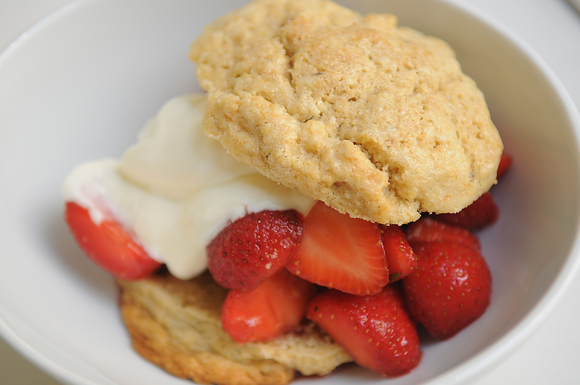
Don't let the summer go by without making strawberry shortcake, especially while you can still get good strawberries. If you know how to make a biscuit or a scone, then you can make a luscious strawberry shortcake. Biscuits, strawberries and whipped cream -- together they make the quintessential summer dessert. 


This treasured book is my go-to source for biscuits and scones. It has a great recipe for Strawberry Shortcakes made with homemade biscuits. It couldn't be easier.

Charlotte Walker's Strawberry Shortcakes

3 cups all-purpose flour
1/4 cup granulated sugar
2 tablespoons baking powder
3/4 teaspoon salt
1/2 pound (2 sticks) cold unsalted butter, cut up
2/3 cup milk
2 quarts strawberries, hulled and sliced; sprinkle with a little sugar
1 egg beaten with 1 tablespoon water

Put flour, 1/4 cup sugar, baking powder, and salt into a large bowl; stir to mix well. Add butter and cut in with pastry blender or rub in with your fingers until the mixture looks like fine granules. Add milk; stir with a fork to form a soft dough, adding more milk if needed. Turn out dough onto a floured surface and give 8 to 10 kneads. Roll or pat dough to a 3/4-inch thickness. Cut out shortcakes with a 2- or 21/2-inch round cutter; re-roll and cut the scraps. Place apart on an ungreased cookie sheet. Cover with plastic wrap and refrigerate 30 minutes or up to 24 hours. Heat oven to 375 degrees. Brush shortcakes with beaten egg. Bake 14-16 minutes, or until lightly browned. Serve the shortcakes warm in a basket. Let everyone split a warm shortcake and fill with berries and Creme Fraiche.

********

Put this together while strawberries are still in season. You can freeze the unbaked biscuits (place cookie sheet with unbaked biscuits in freezer; when biscuits are frozen, put them in a freezer bag) and pull them out and bake them anytime for this homey dessert. Be sure to eat it outside on your porch or patio or, even better, on a blanket under a tree. And don't forget to take along your copy of "Emma." The strawberry-picking scene at Donwell Abbey is such a great summer scene. And these long summer days are perfect for dining outside and reading in the garden.

Friday, January 18, 2013

What Would Jane Think?

Keira Knightley and Rosamund Pike in the 2005 film "Pride and Prejudice"

It is interesting to think about Jane Austen and what she would have thought about her fame today. Could she ever have imagined the extent of it?   It is amazing to think of all the movies, television series and books that have been based on her novels and her life.  She is one of the most beloved and well-known writers in the world and her future fame was surely beyond her imagination.  She would certainly have been astonished and delighted by all the attention the 200th anniversary (on January 28) of "Pride and Prejudice" is getting.  She called this book her "darling child." There are lectures, newspaper and magazine articles, radio programs, exhibitions, and even a BBC television special which recreates the Netherfield Ball as described in "Pride and Prejudice." (Read more here.)   It was shot on location at Chawton house in Hampshire, England, the home of Jane Austen.  All of these programs and articles are examining the reasons for and celebrating the enduring popularity of this novel.

Take a look at this short film about Jane Austen called The Divine Jane.  It was part of an exhibition I saw at the Morgan Library in New York two years ago, A Woman's Wit: Jane Austen's Life and Legacy.   In this excellent film, actors, writers and scholars talk about Jane Austen and what she has meant to them.      

Part one of "The Divine Jane"

Part two of "The Divine Jane"

I hope you enjoy it!

Monday, January 7, 2013

Happy 200th Anniversary, Pride and Prejudice


Happy Anniversary, Jane Austen!  Congratulations on the 200th anniversary of "Pride and Prejudice," the book that you called your "darling child."


"Pride and Prejudice" was published two hundred years ago on January 28, 1813.  It is a truth universally acknowledged that it is one of the most beloved books ever written.  It is Austen's most popular novel and, in fact, Jane Austen herself was very happy with it.  She wrote her sister Cassandra: "I want to tell you that I have got my own darling child from London" on receiving her first copy of the book.  Since then the book has become a celebrated classic.  Its original title was "First Impressions" which refers to the book's main theme:  the problems that occur from acting on first impressions of people, without getting to know them better.        


The first line of the book is one of the most famous first lines in literature.


"Pride and Prejudice" was published in three hardcover volumes costing 18 shillings. The publisher was T. Egerton of London who paid 110 pounds for the rights.  He soon made more than four times that from the first two editions of the book, both published in 1813.

Anne Hathaway as Jane Austen in the film "Becoming Jane Austen"

All six of Jane Austen's novels have been made into multiple films and television mini-series.  In 1995 "Pride and Prejudice" was made into a five-hour British mini-series starring Jennifer Ehle as Elizabeth Bennet and Colin Firth as Mr. Darcy.  This version is often sighted as the best screen adaptation of the book.  In 2005, the book was made into a sumptuous film adaptation directed by British director Joe Wright.  It starred Keira Knightley as Elizabeth and Matthew Macfadyen as Darcy.  There was even a film made about Jane Austen's life (a romanticized version with more fiction than fact) in 2007 --  "Becoming Jane," which starred Anne Hathaway as Jane Austen and James McAvoy as her romantic interest Tom Lefroy.  

The 2005 film of "Pride and Prejudice"

In "Pride and Prejudice" Austen created the unforgettable Bennet family -- five daughters anchored by the intelligent, witty and sensible Lizzie Bennet, a silly mother whose goal in life is to get her daughters married, and the long-suffering father Mr. Bennet who hides from them all in his library.

Jennifer Ehle as Elizabeth Bennet

With Elizabeth Bennet, Austen created one of the most beloved heroines in literature

"I must confess that I think her as delightful a character as ever appeared in print, and how I shall be able to tolerate those who do not like her at least, I do not know."  Jane Austen in a letter to her sister Cassandra, January 29, 1813

"Mr. Darcy had at first scarcely allowed her to be pretty; he had looked at her without admiration at the ball; and when they next met, he looked at her only to criticize.  But no sooner had he made it clear to himself and his friends that she hardly had a good feature in her face, than he began to find it was rendered uncommonly intelligent by the beautiful expression in her dark eyes.  To this discovery succeeded some others equally mortifying.  Though he had detected with a critical eye more than one failure of perfect symmetry in her form,he was forced to acknowledge her figure to be light and pleasing; and in spite of his asserting that her manners were not those of the fashionable world, he was caught by their easy playfulness.  Of this she was perfectly unaware; to her he was only the man who made himself agreeable nowhere, and who had not thought her handsome enough to dance with."

Colin Firth as Mr. Darcy

And with Mr. Darcy, she created one of the most romantic heroes


I have always loved the novels of Jane Austen.  With the 200th anniversary of "Pride and Prejudice" coming up, it has been interesting to think about why this book is so popular and why it has stayed eternally fresh.  Maybe it is because Austen's themes are as relevant today as they were at the time of the novel:  love, friendship, money, reputation and personal happiness.  Though she spent most of her life in a small village in the English countryside, Jane Austen understood more about human nature than most.  As the narrator, she communicates her observations about people and delivers her funny social satire in a voice that is wise, ironic and sisterly.  The comedy and wit of the book are as appealing today as they were 200 years ago.  With Elizabeth Bennet, she created a heroine with whom women can identify and most readers love.  And although customs and costumes have changed, this book (as well as her others) contains universal truths that never go out of style.   


But perhaps the theme that keeps readers coming back for more and filmmakers endlessly adapting this book into films is the romance.  In Austen's time, arranged marriages and marriages of convenience were common and yet her heroines are determined to find true love.  "Pride and Prejudice" contains one of the world's most cherished love stories, and, as in most love stories, the hero and heroine have to deal with many stumbling blocks along the way before they can find true happiness.  Like all of Austen's books, "Pride and Prejudice" ends with a marriage and the reader is swept away into the romance and the promise of life lived happily ever after.  And, if truth be told, we all love a happy ending.

We know from her letters that Jane Austen was pleased with "Pride and Prejudice" and her delightful heroine Elizabeth Bennet.  But it would have been hard for her to imagine that 200 years later her book is still being read and adored by millions of fans around the world and is considered to be one of the greatest novels of all time.


Photos one, three, and six via here,  four, eight and ten via here, seven via here, nine via here, and others via pinterest.  

Monday, October 8, 2012

New Cookbook for Fall

"Nothing I like better than a baked apple."  
--  Jane Austen, "Emma"


Amy Traverso has written a new cookbook all about apples.  As she writes in her introduction, Traverso's love affair with apples hit an all time high when, on October 4, 2004, she married her husband in the apple orchard of Arrows Restaurant in Ogunquit, Maine.  As their guests arrived, they  served them cider made from the apples in the orchard. They set small wedding cakes on each table with tiny Lady Apples scattered around them.  Traverso's bridesmaids wore shades of red and rose, and the groom and his groomsmen wore apple-green ties.  The wedding favors were caramel apples.   As she writes, "Really it was a harvest festival disguised as a wedding."  Sounds beautiful to me!


If you've ever been to Ogunquit, Maine or to any apple orchard in the fall, you understand the poetry of the apple and what it must have meant to Amy Traverso.  Apples are the very essence of fall and apple orchards and farmers' markets at this time of year are nothing short of paradise for the enthusiastic cook.  Traverso's new cookbook takes us through the history of apples, lists the many varieties of apples, offers cooking tips on peeling, coring and preparing apples, and pantry notes about their storage. She gives us hundreds of recipes for both savory and sweet apple dishes.  The photographs are luscious and as I looked through the book yesterday I was overcome with the urge to jump in the car and go to the market immediately and load up on some of the apples that Amy Traverso was describing.


I bought Jonagold and Golden Delicious varieties and decided to make one of the recipes from the book.  I chose the Apple Brownies.  Traverso describes these as very moist and having great fruit and cinnamon flavor.  They are baked in a brownie pan, but the texture is much lighter than a brownie.  Most importantly, they are incredibly easy.  I threw the recipe together in about 20 minutes and it took  40 minutes for the brownies to bake.  They filled the house with the most delicious flavors of fall.


The recipe was a success, though the brownies are a little hard to cut neatly.  Because mine weren't exactly photogenic -- though delicious -- I am showing you how they look in the October issue of "Martha Stewart Living" which includes Traverso's recipe in the magazine's article about apples.

Photo and recipe via here

There are so many tempting recipes in this book.  I would love to make Apple Cranberry Scones; Sweet Potato, Apple, and Ginger Soup; Squash and Apple Gratin; and Apple Bread Pudding with Salted Caramel Sauce.  If you enjoy cooking with apples, you will love this cookbook.  In addition to the many delicious  recipes throughout, you will love Traverso's descriptions of visiting different apple orchards and farms all around the country.  These short essays are at the beginning of each chapter.  Amy Traverso has discovered the poetry of apples.  My favorite quote may be her description of the heirloom Ashmead's Kernel apple that "tastes like champagne with honey stirred in."

If you buy this book, be prepared to rush out to the closest farmers' market to buy some Braeburn, Calville Blanc D'Hiver, Honeycrisp, Golden Russet, or Pink Lady apples -- just to name a few of the heirloom apples that Traverso writes about in her inspiring new cookbook.  

Friday, September 21, 2012

Beautiful New Edition of "Emma"


"Emma Woodhouse, handsome, clever, and rich, with a comfortable and happy disposition, seemed to unite some of the best blessings of existence; and had lived nearly twenty-one years in the world with very little to distress or vex her." -- Opening line of "Emma" by Jane Austen

Do you have a favorite book by Jane Austen?  "Pride and Prejudice" is the favorite of most people and   "Emma" is the second favorite.  I love them both, but seem to return to "Emma" more often.  Maybe the reason for this is that no matter how misguided Emma is in her matchmaking pursuits, her heart is in the right place.  And I love watching her grow and learn about herself.  Her mistaken interpretations of people and the world around her lead to all kinds of problems, but at the end of the book when she changes and has learned about herself and others, we love her.  And who can resist the moment when Emma realizes she is in love with Mr. Knightley!    If you are a fan of Jane Austen or know someone who is, you will love this new annotated gift edition of "Emma" published by Harvard University Press. It would make a great holiday gift for anyone who loves classic books.

It opens with an old-fashioned map showing us the part of England where the small village of Highbury is supposed to be located.  That is the spot where most of the action of the novel takes place and many of the details of the characters' lives in this small village are discussed in this new edition of "Emma."  Throughout the book are illustrations and notes explaining subjects as varied as the English militia in the nineteenth-century, a woman's dowry, Regency clothing, a game of whist, nineteenth-century Bath, and Austen's use of language.  There are beautiful paintings and illustrations throughout that help us picture the Regency-era world in which "Emma" takes place.   This book is filled with gems.  Look for the two different illustrations of Mr. Knightley's proposal to Emma from 19th-century editions of the book.

This is the kind of book you will want to dip into and read on a chilly fall or winter day, preferably with a cup of tea at your side and a fire burning in the fireplace.  And once you get one for yourself, be sure to add it to your holiday gift list for anyone who loves books.

Tomorrow is the first day of autumn.  Have a great weekend!  

Friday, June 15, 2012

Picnics and Jane Austen

"They had a very fine day for Box Hill...Nothing was wanting but to be happy when they got there.  Seven miles were travelled in expectation of enjoyment, and everybody had a burst of admiration on first arriving..."
-- "Emma" by Jane Austen


The Cotswolds, England -- June, 2010

Books and travel take us places.  Sometimes when we travel, we notice things that remind us of something we have read in a book.  In fact, we may be at our travel destination because of a book.  After all, we read for images and we travel for images, and those images can stay with us forever.  It is not surprising that they intersect.

When I was in the English countryside for a garden tour and saw this vista in the Cotswolds, I was reminded of the Box Hill Picnic from Jane Austen's novel "Emma."  "Emma" is one of my favorite books and has always been a book that can take me to a cozy place.  No matter how badly behaved she is, I think we all love Emma.  Her heart is in the right place, though it is sorely tested during the episode of the Box Hill picnic.   And even though the Box Hill picnic was in another part of England, I thought that this vista in the Cotswolds with the verdant hill in the distance looked as if it could have been the setting for the misguided outing that forms the core of Jane Austen's great novel.

Image via here

All the main characters were part of that expedition to Box Hill -- Emma, Mr. Knightley, Miss Bates, Mr. and Mrs. Elton, Frank Churchill, and Jane Fairfax.  They made the leisurely trek, chatting as they walked along, pointing out the beautiful highlights of the surrounding landscape.  It was an idyllic scene.  Mr. Woodhouse would have been safely deposited in an armchair in front of the fire at Donwell Abbey (Mr. Knightley's residence), happily looking at Mr. Knightley's books as he awaited the group's return.

Travel and books supply us with vast amounts of images to store in our memory bank.  It is exciting when the two worlds intersect.  In many respects, Jane Austen led me to the English countryside.  I already knew that part of the world from her books before I ever visited.  Those novels sent me there.  I hope these images from the English countryside and Jane Austen inspire you to get outside this month of June and have a picnic.  It is one of the quintessential summer pleasures and a great mood lifter.  Throw a blanket on the grass and be sure to include strawberries and champagne.  It will lead you on a beautiful journey of images and you may find yourself remembering a special scene from one of your favorite books.