Showing posts with label Writers. Show all posts

Wednesday, December 14, 2016

"To Walk Invisible"

A scene from the television film "To Walk Invisible"
Photo via here

If you are a fan of the Bronte sisters (Charlotte, Emily and Anne), the authors of some of the most iconic novels in the English language, you will be very happy to hear that a dramatization of their lives will soon be airing on PBS.  Sally Wainwright, the creator of television shows such as "Happy Valley" and "Last Tango in Halifax," has just completed a new film for the BBC, "To Walk Invisible." It has been shot in Haworth, Yorkshire, where the Bronte family lived, and from the photos I have seen it looks breathtaking. I have always been enthralled by the story of the Brontes -- their humble beginnings, remote setting in Yorkshire, tragically short lives, and the literary masterpieces they produced  --  a personal story as riveting as any of their books. Now it will be told in what looks to be a brilliant television production. The lucky viewers in Britain will get to see it this month. We will have to wait until March when it will be broadcast on Masterpiece Theatre.

Here are a few things I have learned about this upcoming television production:

Sally Wainwright was approached by the BBC to do something for the 200th anniversary of Charlotte's birth in 2016. Rather than do a series about their entire lives, she decided to focus on the four surviving Bronte siblings (Charlotte, Emily, Anne and Branwell) as mature adults. Siblings Maria and Elizabeth had died of tuberculosis as young children.

The film will be 90 minutes long and covers the years 1845-1848. These are the last years of their brother Branwell's life. He was a troubled young man and during this time he sank into alcoholism, drug addiction and disturbing behavior. He died from alcoholism in 1848 at age 31.

The film depicts the domestic situation of these three women living with a disturbed brother and how they dealt with his problems. This is also the time that they tried to publish their books. It was an uncomfortable situation at home and yet they continued to write and create their literary masterpieces. I can't wait to see this!


********

Another wonderful event in honor of the 200th celebration of Charlotte Bronte's birth is the Charlotte Bronte exhibition in New York at the Morgan Library which I just visited for the second time. It's up until January and if you are in New York be sure to see this.


The original manuscript of "Jane Eyre" on loan to the Morgan Library
Photo via here

Here are the highlights:

A portion of the original 1847 manuscript of "Jane Eyre" ( photo above) on loan from the British Library and shown in the U.S. for the first time. It is open to the page on which Jane tells Mr. Rochester: "I am no bird; and no net ensnares me: I am a free human being with an independent will; which I now exert to leave you." Seeing this treasure was very special and I have to admit to getting a little emotional.

The only surviving portrait of Charlotte, Emily and Anne Bronte painted by their brother Branwell which has never been seen in this country before. It resides in the National Portrait Gallery in London.

A blue floral dress worn by Charlotte in the 1950's 

Drawings and watercolors by Charlotte that demonstrate her artistic talent

The tiny books written by the Bronte children in a nearly microscopic handwriting. Magnifying glasses are nearby to help viewers read them. The children wrote fantasy fiction set in Glass Town, Angria and Gondall, imaginary lands populated by aristocrats, poets and swashbuckling heroes. 


I walked out of this exhibition touched by the poignancy of Charlotte Bronte's short life. She died three weeks before her 39th birthday while pregnant with her first child. Just nine months earlier she had married the curate at Haworth, Arthur Bell Nicholls.  She had watched all of her siblings die, including Emily at age 30 and Anne at age 29. It is awe-inspiring to think of all that she wrote and the celebrity she achieved considering her personal life. After her death her father Patrick Bronte and her husband Arthur Nicholls worked hard to protect her literary legacy. Fans of her books began making the pilgrimage to the Bronte Parsonage in Haworth, England just a few years after her death. The flow of visitors continues to this day. Nothing has changed except the sheer volume of admirers and each year the streets of Haworth teem with devoted fans of the Brontes. I am planning a trip for 2017. I am so happy that I got a chance to see this exhibition twice!    

 I would love to know:
Do you have a favorite Bronte sister? What is your favorite Bronte book?
Have you visited the Bronte Parsonage in Haworth?

Monday, October 24, 2016

A Virginia Woolf Kind of Day


There are times when the perpetually blue skies and sunny weather of Los Angeles make me very happy. In fact, I would say that is the case most of the time. But there are also times when my mood craves "a scene of wet lawn and storm-beat shrub, with ceaseless rain sweeping away wildly before a long and lamentable blast" as Charlotte Bronte described in "Jane Eyre." This is the kind of weather that necessitates staying indoors and for me that means curling up in front of a roaring fire and reading. Or writing. Or maybe just daydreaming. There is something about the darkness of English skies that feels conducive to inner life. It may be confining, but there can be pleasure in confinement. And conversely there is the sense of promise and gratitude that comes when the skies finally clear and we can go outdoors. Something about those contrasts makes life seem a little more vivid.

Yesterday was one of those days. The sky was filled with dark clouds throughout the morning, making it truly feel like fall. The sun peeked in and out all afternoon, the temperature was in the sixties, and it was the perfect day to get some reading done.  Later that evening it rained. Fortunately I had a delightful assignment in front of me. My garden book club has turned out to be a very interesting group. We meet every other month to discuss garden books. However, as with most literature, one things leads to another and garden books have taken us in unexpected directions. For example, many of the gardens we read about belonged to writers. And so we've had some great discussions about Edith Wharton's garden and "The House of Mirth," Vita Sackville-West's garden and "All Passion Spent," and now Virginia Woolf's garden and "Mrs. Dalloway."

Yesterday I started reading "Virginia Woolf's Garden." This book is very special to me because I have visited Virginia Woolf's garden at Monk's House, Virginia and Leonard's country retreat in Sussex (go here to read more). It is a modest house filled with atmosphere and reminders of the lives lived there: the sitting room painted in Virginia's favorite shade of green (despite her sister Vanessa's disapproval) where the Bloomsbury Group would gather for late night conversation, the dining room chairs with their needlepoint cushions stitched by Duncan Grant's mother, and Virginia's bedroom filled with her beloved books and a mantlepiece decorated with a lighthouse painted by her sister Vanessa. The garden is the biggest surprise. It was Leonard's gift to Virginia, a haven where they could both relax and she could work on her books. From the overgrown land behind the house, they created a brilliant patchwork of garden rooms, linked by brick paths, secluded behind flint walls and yew trees. Virginia wrote most of her major novels at Monk's House. She worked in a little writing hut nestled into a corner of the orchard. She could often be seen walking the grounds as she spun her narratives and created her characters.

The Foreward to "Virginia Woolf's Garden" was written by Cecil Woolf, Leonard's nephew. He recalls a time before the Second World War when he stayed at Monk's House with his uncle and aunt. He spent an entire weekend there and remembers arriving, pushing open the creaking wooden gate, and being greeted by Leonard and his pack of excited dogs. Virginia, interrupted by the barking of the dogs, came strolling across the lawn from her little writing cabin. He writes,

"It would take an horticultural epic -- for which my abilities as a poet and my knowledge as a gardener are unequal -- to do full justice to the little Eden I remember. Leonard and Virginia had no children: their books and garden were their children. My recollections of the garden are inevitably somewhat impressionistic. From the overgrown land behind the house that the Woolfs bought twenty years earlier, they had created a spectacular mosaic of brightly coloured flowers...merging into vegetables, gooseberry bushes, pear trees, apple trees, figs. Here and there on the lawn were scattered goldfish ponds. Beside the flower garden and orchard, there were the beehives and the greenhouses, where Leonard had an extensive collection of cacti and succulents. Unlike the grand and formal gardens at Sissinghurst, created by Virginia's close friend Vita Sackville-West, the Woolf's garden was organic, delightfully informal and less self-conscious."

This book is written by Caroline Zoob who lived with her husband at Monk's House for over a decade as tenants of the National Trust. During those years they tended and planted the garden as other tenants had done before them. She tells the story of how the garden has evolved since 1919, when the Woolfs bought the house, to the present day. I have read that this book will appeal equally to gardeners as well as those with an interest in Virginia and Leonard Woolf. I'm looking forward to reading it alongside "Mrs. Dalloway." It should be interesting to learn about this magical garden that formed a safe haven and inspiring environment for Virginia as she wrote one of her masterpieces. For the next two weeks I will be immersed in the world of Virginia Woolf and I am looking forward to my book group's discussion of one of my favorite authors and her garden.

Wednesday, May 18, 2016

What Is Your Muse?


What is your muse? We are all compelled by something. It may be great books, art, design, fashion, film, history, an influential personality, great writer, artist, or entrepreneur. Charlotte Moss writes in her new book Garden Inspirations that the garden is her greatest muse. She brings it into her life wherever she can. The garden informs and enriches her surroundings. It influences her aesthetic as a decorator. She is inspired by the great women gardeners throughout history: Vita Sackville-West, Edith Wharton and Beatrix Farrand, to name a few. To read her beautiful new book is to learn how one's woman passion has affected her entire life.

I began to think about mine. I have always believed that a place can be a muse and there is no question that I have a love affair with England. Its writers, artists, history, castles, cathedrals, great houses and landscape have inspired me since I was in college and spent six years reading English novels and poetry. Those books became part of me. They affected my entire life and inspired my love of great books and excellent writing. It is a passion that continues today.

I remember my first trip to England and visiting the places that filled my imagination. I saw the landscapes, the gardens, the little villages, the pubs, the monuments, the pageantry and the historic sites I had been reading about for years. I had a proper English tea, the kind that seemed to occur in all my favorite novels. I discovered London, the setting for so many of my favorite books and it was a revelation. A modern bustling city with beautiful parks and green spaces and a thousand-year old history lurking around every corner if you took the time to look. And there was the glorious countryside. Right out of a novel by Thomas Hardy or a poem by William Wordsworth. My goal was to walk on country lanes, have tea and scones, poke around little villages, and read in rustic settings just as all of my favorite heroines had done. On that first trip I made a special point of visiting as many writers' houses as I could. Seeing the objects that surrounded them was thrilling.

Over the years I have brought home many memories and souvenirs from my trips to England. Even on my very first trip, when I was living on $5.00 a day, I was collecting post cards from my favorite museums. I went to Fortnum and Mason and bought two cups and saucers by Wedgewood, little realizing this was the beginning of a china obsession. And then there were the books. I discovered bookstores like Hatchards, a heavenly place for any book lover. I didn't mind buying new editions of books I already had since the cover art was so different and often more beautiful. I still go to Hatchards, Heywood Hill, John Sandoe and Persephone Books on each and every trip and browse in utter contentment.

When my husband and I traveled together to England for the first time we stumbled upon a book fair in London. Bloomsbury was already a passion of mine and I was thrilled to find a little book of poetry by E.M. Forster that had been published by Virginia and Leonard Woolf. It was my first Hogarth Press book. When we traveled to Lewes in Sussex to look for Virginia Woolf's house, we wandered into a little gallery where we found a drawing by Duncan Grant. Those two purchases were so exciting. And so it began... books fill our bookcases, images of favorite writers decorate my study, and art hangs on our walls. Tea pots, cups and saucers peek out of the cabinets in the kitchen. All memories and reminders of a love of England.

But the greatest reward I gained from all that reading and those visits to England was a love of the written word. Books are my passion. Over the years I've discovered many writers to add to my list of favorites: Nancy Mitford, E.F. Benson, Barbara Pym, Jane Gardam, E.M. Delafield, Angela Thirkell, Elizabeth Taylor and Isabel Colegate, just to name a few. They inspire me with their words and stories and motivate me to write something of my own. Great art can inspire personal dreams. That's the thing about a muse -- if you keep an open mind, it will lead you towards creative fulfillment.

 I would love to know what is your muse?
And, are you an Anglophile?

Monday, April 4, 2016

Hello, April!


"...before she had been five minutes within its walls...she quitted it again, stealing away through the winding shrubberies, now just beginning to be in beauty, to gain a distant eminence."
-- Jane Austen, Sense and Sensibility

It's hard to believe that April is here. Wasn't it just Christmas? Well, spring has truly arrived and it's always an exciting time for gardeners. Inspired by the new month, I made myself a cup of tea and pulled out some of my favorite garden books. I perused In the Garden with Jane Austen by Kim Wilson, a lovely book I bought last time I was in England. This book is about two of my favorite things: gardens and Jane Austen. Both are purveyors of so much pleasure. I should have known that someone would write a book about the two of them. I am happy to say that this book is an utter delight -- beautiful and informative. Here are some of the interesting facts I learned about the connections between Jane Austen and gardens:

Not surprisingly, Jane Austen was a garden lover. But she was also a hands-on gardener. No matter where she was living, she took an avid interest in flower gardening and kitchen gardening alike. 

The Austens grew their own food whenever they could and had flower gardens in most of their homes. In Jane's letters to her sister Cassandra she writes about her ideas for the planting of fruit, flowers, and trees. At Chawton cottage they planted peas, potatoes, gooseberries, currants and strawberries. Their favorite flowers were pinks, sweet Williams, hollyhocks, and columbines. Suitably old-fashioned!

During her life, Jane visited many of the grand gardens of England, including her brother's two estates at Chawton and Godmersham and the manor houses of friends and family. Scholars have speculated that she probably saw the gardens at the great estate of Chatsworth; it was probably the inspiration for Pemberley, Darcy's magnificent estate in Pride and Prejudice.

Gardens play a big role in her novels. Every house that is mentioned includes a garden and many of Jane Austen's characters find themselves there. Gardens are places for walking, talking and scheming. They are places of peace and spiritual refreshment. And they are settings for romance, marriage proposals and weddings. 

The Austen women had moved from house to house after Jane's father died in 1805, but Chawton Cottage finally provided them with a place to call home. Although the Austen family lived modestly, Jane's brother Edward became a rich man when he was adopted by the Knights, a wealthy, distantly related family who were childless and needed a male heir. He took their name, becoming Edward Austen Knight. He was generous to his mother and sisters, offering them a choice of two houses he had inherited through the Knight inheritance. They chose Chawton Cottage. Doesn't this all sound familiar? It reminds me of Emma and Sense and Sensibility. Jane was writing what she knew. 

The Jane Austen House Museum is a beautifully restored interpretation of what Chawton Cottage was like when Jane Austen lived there. It is open to the public. The gardens contain examples of a working kitchen garden, espaliered fruit trees, a shrubbery, a herb garden, a rose garden, and numerous flower borders. All as it would have looked during Jane's lifetime. Inside the cottage there are family pictures, china, and furniture, including the little round table on which she wrote her novels.

After reading about Chawton Cottage, I became curious about its restoration and wondered when it happened and who was responsible. I got some answers from another garden book I love: The Writer's Garden by Jackie Bennett. Naturally there is a chapter on Jane Austen. Here is what I learned about the restoration. It is a fascinating story--

In 1940 two sisters, Dorothy and Beatrix Darnell, established the Jane Austen Society in order to rescue Chawton Cottage. However they did not receive all the money necessary for the restoration. A savior appeared in the form of Mr. T. Edward Carpenter. He bought Chawton Cottage and set up the Jane Austen Memorial Trust, opening the cottage as a museum in 1949. But in 1987 it was in a serious state of neglect. That was when an American entrepreneur and philanthropist, Sandy Lerner, stepped in and came to the rescue. An Austen fan and collector of early women's writing, she bought the lease on the house and set about restoring the house and gardens. She is responsible for its current condition. She also donated her own collection of rare books which, together with the Knight family books, created a library of 11,000 rare volumes. This became the Chawton House Library. The saga of saving the house and the people responsible could be the topic of another book! I would love to know more...   

Isn't it inspiring to learn about the angels who sweep in and save important historic homes and gardens, allowing the rest of us to enjoy them. Their generosity and devotion enable us to learn about the domestic lives of some of our most beloved authors.

If you enjoy garden books, you will love In the Garden with Jane Austen and The Writer's Garden. Both of them are lovely places to escape on a spring day. They will remind you of how important gardens were in so many writers' lives.

Wishing you a lovely first week of April!

Monday, April 27, 2015

Contemplating Books


Do you know about The Grolier Club? It is a sanctuary for book lovers. I discovered it just a few years ago when they were hosting a Virginia Woolf book exhibition. I was so excited about that one. Unfortunately I wasn't in time to see the exhibition, but I went in anyway and fell in love. Now I visit every time I'm in New York.

The ground floor gallery of the Grolier Club

The space is absolutely gorgeous and its all about books. So, you might ask, what is the Grolier Club?

Here is their mission statement:

Founded in 1884, the Grolier Club is America's oldest and largest society for bibliophiles and enthusiasts in the graphic arts. Named for Jean Grolier (1489-1565), the Renaissance collector known for sharing his library with friends, the Club's objective is to foster 'the study, collecting, and appreciation of books and works on paper.' The Club maintains a research library on printing and related book arts, and its programs include public exhibitions as well as a long and distinguished series of publications." 


It's fascinating to read about the exhibitions they have put on over the years, all of them free and open to the pubic. There have been over 800 exhibitions on topics as varied as William Blake, Rudyard Kipling, chess, murder mysteries, Japanese prints, and Art Nouveau posters. There are 8 exhibitions a year, four in the ground floor gallery, and four in the second floor gallery. Anyone can walk in the door and view the exhibitions. There are lunchtime exhibition tours, afternoon lectures, and evening panel discussions. The space itself is lovely, with the coziness and intimacy of a small house. The publications that go along with the exhibitions are exquisite books. I have bought several over the years.

Last week when I was in New York, I went to the Grolier Club to see what was going on

 I took the stairs to the second floor gallery

 Where there was a small exhibition along the walls of the landing 


This exhibition was "Victorian Connections" and was about the literary and artistic circles of William and Helen Allingham. He was a poet, scholar and editor and she was a water-colorist and illustrator. They were a Victorian couple and well-connected with the great writers and artists of the time. This is the kind of thing they talk about at the Grolier Club: the Victorian literary and artistic scene in which everybody seemed to know everybody else and its celebrity couples such as Robert and Elizabeth Barrett Browning and George Eliot (Mary Ann Evans) and George Henry Lewes. It was fascinating to think about the "rock stars" of the Victorian era: Charles Dickens, William Thackeray, Julia Margaret Cameron and others. I always learn something new when I visit the The Grolier Club. This place just exudes a reverence for the literary arts and an appreciation of the beauty of books. 

The second floor gallery


In their ground floor gallery was the exhibition: Aldus Manutius, A Legacy More Lasting Than Bronze. I learned that Aldus Manutius, the greatest scholar-printer of the Italian Renaissance, founded the Aldine Press in Venice in 1494. He was the first to print the canon of Greek classics -- Aristotle, Thucydides, Herodotus and Sophocles, the first to print in italic type, and the first to publish books in a portable format, thereby making great literature available to a mass audience for the first time in history. He developed a new type face for his publications that was originally called "Aldine" type; we know it today as italic. Publications of the Aldine Press were treasured and collected even while the Press was still in operation. This exhibition contains more than 130 books published by the Press. It was fascinating to learn about the birth of reading as we know it today. 


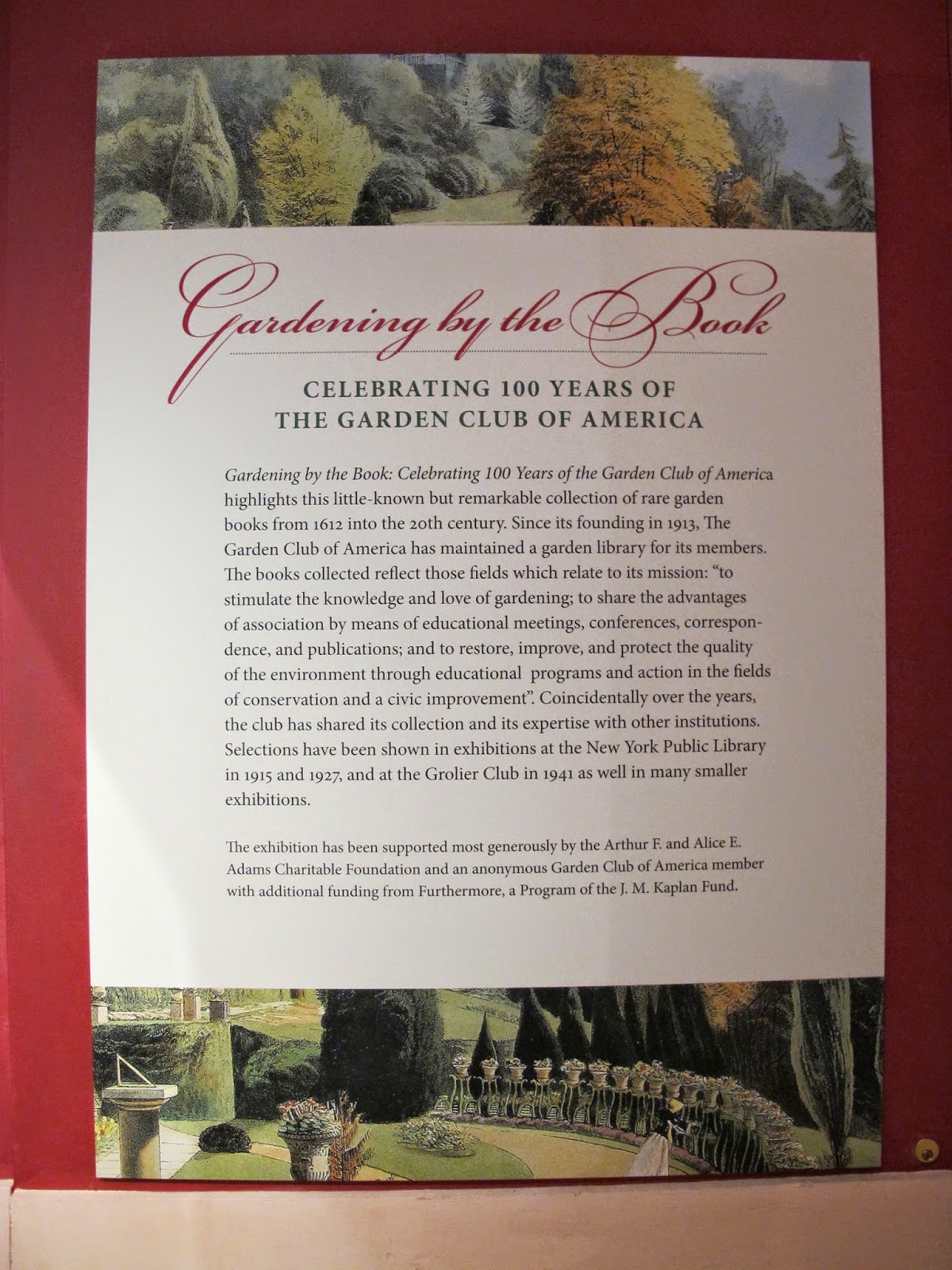
But, my very favorite exhibition was one I saw two years ago -- Gardening by the Book -- which combined two of my loves: books and gardens. It was an exquisite show of rare botanical books as beautifully curated and arranged as any garden. I read that the curators hoped we would "lose our cares and delight our senses in the contemplation of books and gardens." That is definitely what happened to me. Take a look:


The exhibition was in the beautiful first floor gallery and contained a wonderful display of rare old books


It celebrated The Garden Club of America's extensive collection of garden books and prints. The theme was the love and knowledge of gardening and the collecting and preservation of garden literature. It was also a tribute to the 100th anniversary of The Garden Club of America. The unique beauty and individual characteristic of each book was highlighted in the wonderfully designed exhibition cases. Each one was a visual feast.

There were gardeners' tales

Books in bloom

Writers in the garden

The language of flowers

More than125 illustrated volumes about flowers and gardening were presented

Each one a thing of beauty


 It was a celebration of the beauty of botanical books and the joys of gardening

Anyone who is passionate about books would love the Grolier Club. It is a cultural treasure in the heart of NYC. This organization celebrates reading and the written word and values the intrinsic worth and beauty of books as something to be displayed and enjoyed by all. Every time I visit I am inspired. Be sure to visit next time you are in New York. Go here to learn more.