

"Woman with a Book" by Vanessa Bell
"What are you reading?" I ask my friends all the time and they ask me. Everyone is in a book group and we're all talking about books. I am happy to say that during the last few months I have made some serious inroads on my ever-growing stack on my nightstand. And it feels so good! I recently finished four books that I wanted to share with you. They are an eclectic group -- each one is very good and different from the others.
Vanessa And Her Sister by Priya Parmar


"What are you reading?" I ask my friends all the time and they ask me. Everyone is in a book group and we're all talking about books. I am happy to say that during the last few months I have made some serious inroads on my ever-growing stack on my nightstand. And it feels so good! I recently finished four books that I wanted to share with you. They are an eclectic group -- each one is very good and different from the others.
Vanessa And Her Sister by Priya Parmar
At first glance, an historical novel about Bloomsbury sounded intriguing. Though I wondered what more could be said as there has been so much non-fiction material about Bloomsbury over the years -- biographies, memoirs, diaries and letters. But there was one voice that hadn't been heard from even though she was probably the most admired member of the group. That was the voice of the artist Vanessa Bell. She was reserved -- early on her sister, the writer Virginia Woolf, pronounced that she, Virginia, was the writer and Vanessa was the painter. She didn't keep a diary, write a memoir or send many letters. But fortunately the other more verbose members of the group wrote about her. She plays a big part in many of their memoirs and letters. Consequently there was a great deal of source material available for a novelist to drawn upon to invent a diary for Vanessa Bell.
This is what Priya Primar has done in her new novel about Vanessa Bell and the early days of the Bloomsbury Group. It consists entirely of invented diary entries, letters and telegrams, a format that works very well. The book captures the essence of this beloved woman and for the first time gives us an idea of how she probably felt about several big issues: dealing with her brilliant and emotionally fragile sister, the writer Virginia Woolf; learning about the affair between her sister Virginia and her husband Clive Bell; and being an artist during the early days of the modern art movement that was exploding in Paris and London. She was in the middle of it all and somehow managed to stay centered. She also managed to live at Charleston Farmhouse with the love of her life, the artist Duncan Grant, for fifty years. It was there that they created art together, painting in their studio and glorious garden. They also decorated the entire house with their artwork.
I finished this book with tears in my eyes. Choosing to write about the early years (1905-1912) in the lives of these two sisters just before both their careers were about to be take off gives the book a poignancy for anyone who knows the outcomes. And focusing on the fraught relationship between Virginia and Vanessa tells the Bloomsbury story in a new way and gives it an unexpected freshness. Be sure to pay attention to the two letters that frame the book. I had to go back and reread them to understand their significance. Parmar includes an addendum that lets us know what happens to all of these people in later years. Don't miss this book, whether you are a fan of the Bloomsbury Group or not. I loved it.
I finished this book with tears in my eyes. Choosing to write about the early years (1905-1912) in the lives of these two sisters just before both their careers were about to be take off gives the book a poignancy for anyone who knows the outcomes. And focusing on the fraught relationship between Virginia and Vanessa tells the Bloomsbury story in a new way and gives it an unexpected freshness. Be sure to pay attention to the two letters that frame the book. I had to go back and reread them to understand their significance. Parmar includes an addendum that lets us know what happens to all of these people in later years. Don't miss this book, whether you are a fan of the Bloomsbury Group or not. I loved it.
My Brilliant Friend by Elena Ferrante
I only recently learned about Elena Ferrante. I read an excellent article in the New York Times and knew I had to read one of her books. She is an Italian writer whose identity remains a mystery; she publishes under a pseudonym and fiercely guards her privacy. "My Brilliant Friend" is the first book in what is known as her "Naples series." It is about a young woman named Elena -- her childhood and adolescence in the rough neighborhoods of Naples. It is also about her intense and competitive friendship with her friend Lila.
This book took me a long time to get into because of the raw and violent nature of its story. But once I dropped my resistance I felt the power of the author's theme: a friendship between two women that seems unbreakable despite the most difficult odds. I became fascinated by their story of growing up in the working classes of Naples in the 1950's amidst poverty, danger, and violence. And the serious challenges of being a woman in that environment. The two women at the center of the book are polar opposites in many ways and it is the mysterious chemistry that holds them together as friends that is the essence of this novel. It is intense and at times disturbing, but you get the sense that this is an honest depiction of life as it was. This is definitely not cozy fiction, but one that will startle you with its brutal honesty and enlighten you about the rich and complex lives of the women in this culture. I am so glad I read it.
This book took me a long time to get into because of the raw and violent nature of its story. But once I dropped my resistance I felt the power of the author's theme: a friendship between two women that seems unbreakable despite the most difficult odds. I became fascinated by their story of growing up in the working classes of Naples in the 1950's amidst poverty, danger, and violence. And the serious challenges of being a woman in that environment. The two women at the center of the book are polar opposites in many ways and it is the mysterious chemistry that holds them together as friends that is the essence of this novel. It is intense and at times disturbing, but you get the sense that this is an honest depiction of life as it was. This is definitely not cozy fiction, but one that will startle you with its brutal honesty and enlighten you about the rich and complex lives of the women in this culture. I am so glad I read it.
Americanah by Chimamanda Ngozi Adichie
An excellent book about the immigrant experience and race, "Americanah" tells the story of a Nigerian woman Ifemelu and her Nigerian boyfriend Obinze who seek to leave Nigeria for America. After meeting in high school and falling in love, they are both determined to get out of their country which is falling apart under military rule. Ifemelu makes it to America on a student visa, wins a fellowship at Princeton and eventually becomes the author of a successful blog about race. Many of her blog posts are included in this novel and it is her sharp and witty voice that is the soul of the book. However, before she becomes successful, she undergoes the harrowing experience of searching for gainful employment in America. After many rejections, she reluctantly accepts a job of which she is so deeply ashamed that she must hide it from Obinze. It ultimately causes her to end their relationship.
In the meantime Obinze is unable to get to America post-September 11 and goes to London instead where he holds mostly menial jobs. He eventually returns to Nigeria, finds financial success, gets married and has children. But he is never really happy as is unaware of why Ifemelu has broken off their relationship. She comes back as well and settles into life in Nigeria. They both have trouble settling in as they are changed and one of the big themes of this book is the difficulty of fitting back into their culture after becoming an "Americanah." This immigrant saga is a love story as well as a meditation on race. It manages to be very funny as well as sharp in its social commentary. It is thought-provoking on so many issues and beautifully written. I highly recommend this one.
In the meantime Obinze is unable to get to America post-September 11 and goes to London instead where he holds mostly menial jobs. He eventually returns to Nigeria, finds financial success, gets married and has children. But he is never really happy as is unaware of why Ifemelu has broken off their relationship. She comes back as well and settles into life in Nigeria. They both have trouble settling in as they are changed and one of the big themes of this book is the difficulty of fitting back into their culture after becoming an "Americanah." This immigrant saga is a love story as well as a meditation on race. It manages to be very funny as well as sharp in its social commentary. It is thought-provoking on so many issues and beautifully written. I highly recommend this one.
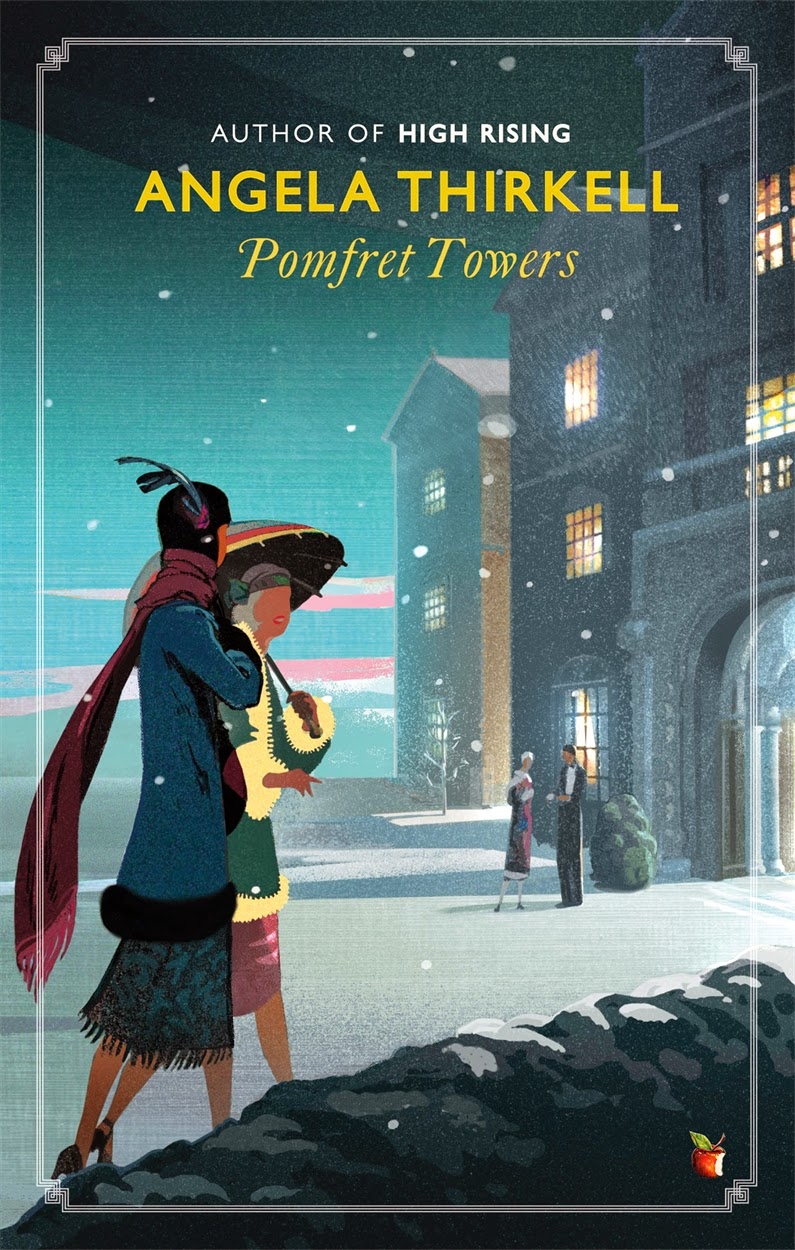
And finally, if you are looking for something light and delicious, look no further than "Pomfret Towers" by Angela Thirkell. Reading her books is like drinking a glass of champagne. These comic novels are set in the fictional English county of Barsetshire, a landscape that Angela Thirkell borrowed from Anthony Trollope. They are about bright young things falling in love amidst ancestral country homes and English eccentrics. Along the way, there is enough comedy and social satire to make you laugh out loud. In the tradition of Jane Austen, each book ends with an engagement.
Most of the action in "Pomfret Towers" takes place during a country house weekend. The Earl of Pomfret has decided to open up his grand house to his neighbors for a house party. His guests of honor are two charming young people: the shy Alice Barton and her brother Guy. They are the children of Mr. Barton, a prosperous local architect and his wife Mrs. Barton, a writer of historical fiction. If you read Angela Thirkell enough, you will notice that there are often writers, editors and publishers in her books. And they are usually the source of comedy. It is as if she is poking fun at her own profession with these characters. In this book she also includes Mrs. Rivers, a writer of romance novels and her publisher Mr. Johns.
Mrs. Barton has decided that this weekend is the time for young Alice to learn to socialize. Alice is terrified of the experience, but makes the effort. It will be a turning point for her. The other guests at the house party are: Julian Rivers, an arrogant young artist; Roddy and Sally Wicklow, an extremely likable and outdoorsy brother and sister; and Giles Foster, nephew and heir of the present Lord Pomfret. Everyone wonders which lucky girl will catch his eye. And although Alice is anxious about the weekend, by the end of it she breaks out of her shell, makes new friends, and falls in love. As in most of Angela Thirkell's books there are several endearing characters who help smooth misunderstandings and solve problems along the way. They will make you smile. "Pomfret Towers" is a total delight.


