Showing posts with label Gardens. Show all posts

Thursday, September 28, 2017

Memorial Garden for Princess Diana

Kensington Gardens

Hello! You may be wondering where I have been and I hope you will forgive me for a very long hiatus. The reason for my absence is some happy family news: a new granddaughter (I now have two!) and a daughter who just got engaged. It's been a busy and wonderful summer. Now that it's fall  I am back at my blog and thought the first post should be about Kensington Gardens. It seemed like a good time to write about my visit last May in light of all the films and articles about Princess Diana on the 20th-anniversary of her death.


Kensington Palace is where Diana lived from the time of her marriage to Prince Charles until her death in 1997. And those gates are where all the flowers were laid -- more than a million bouquets -- in the days following her death. It just so happened that the day we visited was extraordinarily beautiful, one of those gorgeous English days with the bluest sky and huge fluffy white clouds. Prior to this our weather had been gray and chilly. We were delighted to be out and about looking at gardens on such a stunning day.
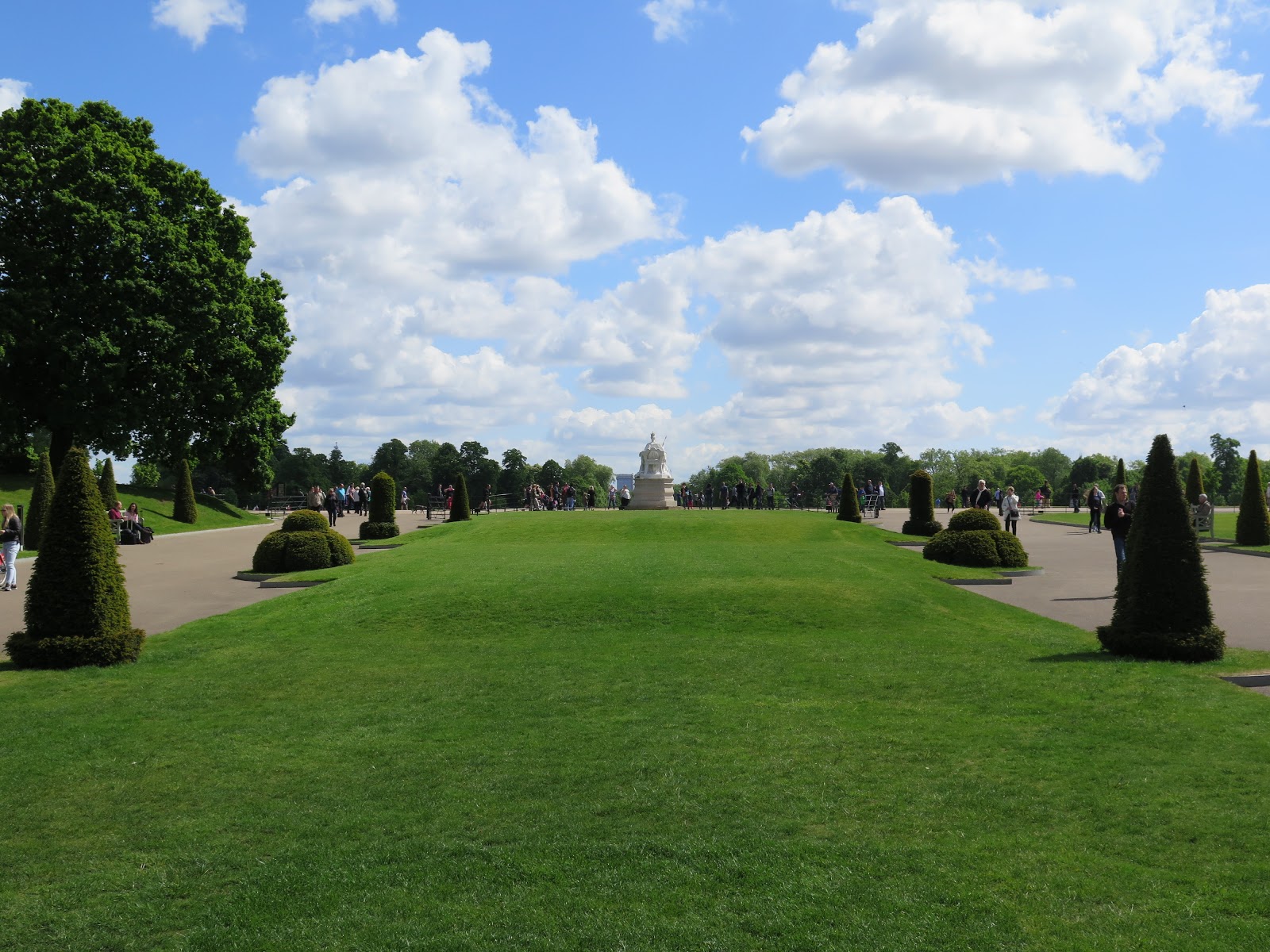

Kensington Gardens is adjacent to Kensington Park which is where we started our walk. Everyone in London seemed to be out that day enjoying the lovely weather. The statue in the distance is of Queen Victoria who also lived at Kensington Palace. We walked through these beautiful grounds and felt invigorated by the gorgeous sky and green parkland.


The historic sunken garden at Kensington Gardens is deservedly famous. The beds of flowers glimpsed through eye-catching arches cut out of the hedges are a treat to see. It's truly such a serene and inspiring place. And this year a white garden was planted in honor of Princess Diana. It closes at the end of this month and I am so happy to have made it to London in time to see this beautiful and moving tribute to Diana.

The gardeners planted white flowers and foliage including roses, scented narcissi and a carpet of forget-me-nots around the existing sunken garden.

They recalled that she was particularly fond of the sunken garden and would often come by to chat with them and admire the changing floral displays.

The white flowers really stood out in this beautiful setting and reminded me of the beauty and elegance of Princess Diana.

Looking through one of the hedged arches lining the perimeter

I enjoyed reading the articles and watching the documentaries about Princess Diana that came out last month. I also watched the film "The Queen" starring Helen Mirren which was about Diana's death and the response or lack of response by the Royal Family. I learned that she was complicated and flawed, filled with insecurity and anxiety, but that's what made her so relatable and real. She was the "people's princess" and is credited with modernizing the monarchy. One thing that was undeniable: she had star power. She was beautiful, photogenic and glamorous. I admired the way she used her celebrity to champion causes that benefited the marginalized, such as people suffering from aids in the early years. I'll never forget the photo of her holding hands with an aids patient and not wearing gloves. I think she would have loved the white garden planted in her honor at Kensington Palace. A garden by its very nature is ephemeral and the fact that it won't last forever made the seeing of it all the more special. Of all the memorials to Diana this may have been the most meaningful.

I would love to know if you got a chance to see this lovely tribute to Princess Diana!


Monday, May 22, 2017

Adventures in Yorkshire


We just got back from a wonderful trip to London and Yorkshire. After a week in London our plan was to visit Haworth where the Bronte sisters lived. The question was: where should we stay? I had been told that York was a wonderful destination and only about an hour from Haworth. Once I began reading up on York I discovered so many interesting things. For example, did you know that York was once the capital of England? And that it is the home to the biggest Gothic cathedral in all of Northern Europe, the York Minster? I learned so much on this trip. But, back to the issue of where to stay. I did a little research and discovered what looked to be a lovely country house hotel just outside the city of York called Middlethorpe Hall. It is a Queen Anne country house that was built by Thomas Barlow in the early 18th-century and lived in by his descendants for many years. One of its most famous residents was the letter-writer and traveler Lady Mary Worley Montagu who rented it in 1713. Eventually the house fell into disrepair and was carefully restored in 1980 and turned into a beautiful hotel. I knew it was on a large piece of land but nowhere did I learn about its gorgeous gardens. Here is what we discovered at Middlethorpe Hall on our very first day. And by the way, don't you think the house itself has a sort of a Jane Eyre look about it? To me it looked like the Thornfield Hall of my imagination. Mr. Rochester or Mrs. Fairfax could have easily opened up that front door!


We entered the foyer and were very happy with what we saw. This is a very authentic and old-fashioned country-house hotel. Inviting and comfortable, it made us feel if we had traveled back in time. Our room was lovely and I wish I had pictures. But to give you a feeling of the authenticity of the building, our bedroom floor was on a slant and creaked like a thunderclap every time we walked on it. Late at night on the way to the bathroom it was easy to imagine ghosts. I loved the ambiance here and it was a great beginning to our Bronte journey. We checked in and quickly unpacked as we wanted to explore.

 There were some very beautiful public rooms

 I could imagine having tea here later


 But our first stop was the terrace at the back of the house where we were told we could get a cocktail

We walked out the back door and sat at one of these little table and had a glass of wine. We noticed that there seemed to be a garden at the end of the terrace. And so we took a walk.

We were greeted by this beautiful tree and noticed a pathway leading to a garden

We followed the path

The borders were lush and beautiful


And there it was -- a series of garden rooms filled with herbaceous borders, fruit trees, pathways, enclosures, long vistas, doorways, hedging, brick walls, and espaliered trees. There was also an 18th-century dovecote. This garden was enchanting and we were the only ones in it! 

There was beautiful hedging and inviting benches

Enticing vistas

Dramatic entrances

Pergolas

Garden doors

With views of more enticing gardens

Espaliered trees

The tulips were gorgeous

As were the alliums

There were arbors

And brick walls

We were happy to have made it in time to see the wisteria

The geometric shapes and symmetry were very inspiring

We followed along until we reached this park-like expanse which led us to the big lawn at the back of the house


Where we discovered the "ha-ha," a concealed ditch which allows views across the south lawn


At this point it was time to change for dinner at the hotel. The wood-paneled dining room was elegant and the food was delicious. We had three wonderful nights at Middlethorpe Hall. Maybe because of its proximity to Bronte Country, staying at Middlethorpe Hall felt a bit like living inside a Victorian novel. The combination of history, beauty, and atmosphere made it the perfect place to stay on our journey to visit the Brontes.

Next up: Haworth and the Bronte Parsonage

Monday, October 24, 2016

A Virginia Woolf Kind of Day


There are times when the perpetually blue skies and sunny weather of Los Angeles make me very happy. In fact, I would say that is the case most of the time. But there are also times when my mood craves "a scene of wet lawn and storm-beat shrub, with ceaseless rain sweeping away wildly before a long and lamentable blast" as Charlotte Bronte described in "Jane Eyre." This is the kind of weather that necessitates staying indoors and for me that means curling up in front of a roaring fire and reading. Or writing. Or maybe just daydreaming. There is something about the darkness of English skies that feels conducive to inner life. It may be confining, but there can be pleasure in confinement. And conversely there is the sense of promise and gratitude that comes when the skies finally clear and we can go outdoors. Something about those contrasts makes life seem a little more vivid.

Yesterday was one of those days. The sky was filled with dark clouds throughout the morning, making it truly feel like fall. The sun peeked in and out all afternoon, the temperature was in the sixties, and it was the perfect day to get some reading done.  Later that evening it rained. Fortunately I had a delightful assignment in front of me. My garden book club has turned out to be a very interesting group. We meet every other month to discuss garden books. However, as with most literature, one things leads to another and garden books have taken us in unexpected directions. For example, many of the gardens we read about belonged to writers. And so we've had some great discussions about Edith Wharton's garden and "The House of Mirth," Vita Sackville-West's garden and "All Passion Spent," and now Virginia Woolf's garden and "Mrs. Dalloway."

Yesterday I started reading "Virginia Woolf's Garden." This book is very special to me because I have visited Virginia Woolf's garden at Monk's House, Virginia and Leonard's country retreat in Sussex (go here to read more). It is a modest house filled with atmosphere and reminders of the lives lived there: the sitting room painted in Virginia's favorite shade of green (despite her sister Vanessa's disapproval) where the Bloomsbury Group would gather for late night conversation, the dining room chairs with their needlepoint cushions stitched by Duncan Grant's mother, and Virginia's bedroom filled with her beloved books and a mantlepiece decorated with a lighthouse painted by her sister Vanessa. The garden is the biggest surprise. It was Leonard's gift to Virginia, a haven where they could both relax and she could work on her books. From the overgrown land behind the house, they created a brilliant patchwork of garden rooms, linked by brick paths, secluded behind flint walls and yew trees. Virginia wrote most of her major novels at Monk's House. She worked in a little writing hut nestled into a corner of the orchard. She could often be seen walking the grounds as she spun her narratives and created her characters.

The Foreward to "Virginia Woolf's Garden" was written by Cecil Woolf, Leonard's nephew. He recalls a time before the Second World War when he stayed at Monk's House with his uncle and aunt. He spent an entire weekend there and remembers arriving, pushing open the creaking wooden gate, and being greeted by Leonard and his pack of excited dogs. Virginia, interrupted by the barking of the dogs, came strolling across the lawn from her little writing cabin. He writes,

"It would take an horticultural epic -- for which my abilities as a poet and my knowledge as a gardener are unequal -- to do full justice to the little Eden I remember. Leonard and Virginia had no children: their books and garden were their children. My recollections of the garden are inevitably somewhat impressionistic. From the overgrown land behind the house that the Woolfs bought twenty years earlier, they had created a spectacular mosaic of brightly coloured flowers...merging into vegetables, gooseberry bushes, pear trees, apple trees, figs. Here and there on the lawn were scattered goldfish ponds. Beside the flower garden and orchard, there were the beehives and the greenhouses, where Leonard had an extensive collection of cacti and succulents. Unlike the grand and formal gardens at Sissinghurst, created by Virginia's close friend Vita Sackville-West, the Woolf's garden was organic, delightfully informal and less self-conscious."

This book is written by Caroline Zoob who lived with her husband at Monk's House for over a decade as tenants of the National Trust. During those years they tended and planted the garden as other tenants had done before them. She tells the story of how the garden has evolved since 1919, when the Woolfs bought the house, to the present day. I have read that this book will appeal equally to gardeners as well as those with an interest in Virginia and Leonard Woolf. I'm looking forward to reading it alongside "Mrs. Dalloway." It should be interesting to learn about this magical garden that formed a safe haven and inspiring environment for Virginia as she wrote one of her masterpieces. For the next two weeks I will be immersed in the world of Virginia Woolf and I am looking forward to my book group's discussion of one of my favorite authors and her garden.

Wednesday, August 3, 2016

Amanda Brooks' English-Country Style

The living room in Amanda Brooks' house in England

If there's one type of architecture that captures my heart, it's an English country farmhouse. The September issue of Architectural Digest arrived just in time to satisfy my passion. There is a great article on writer Amanda Brooks' Oxfordshire house which hits all the right notes:  timeworn ceiling beams, reclaimed wood counter tops, vintage farmhouse kitchen table, unpainted plaster, pine cabinetry, piggery turned into a painting studio, garden shed, boot room, and rose-filled gardens. Sigh... this is my dream house. Take a look at this lovely place, decorated by Amanda Brooks who brought to the decoration her favorite aesthetic -- English-country style which she loves for its "timelessness and lack of pretension." Oh yes, I could live here! This house simply exudes warmth and coziness.

The 1820's farmhouse owned by Amanda and Christopher Brooks

A corner of the living room

Living room

Tea tray in a sunny niche of the living room

Sitting room

Kitchen

Landing

Their daughter's bedroom

Master bedroom


Boot room

Garden shed

Amanda Brooks in her garden

Go here to read more about Amanda Brooks and her Oxfordshire farmhouse. All photos via here.

What is your dream house?